

REVIEW BY ANNA RYLEY
EDITED BY AUDREY MCKENZIE
Taking snapshots of the nameless and lifeless who co-exist amongst us, Everyday stops to consider the rich stories that surround us when we are forced to pause.
I was initially hesitant as to how a play could keep an audience engaged with such a bare set, small cast and minimal action, but I needn’t have worried in the slightest. Written and directed by Avi Walsh-Davis, the ambitious play places characterisation at the heart of everything, with each actor embodying their role so perfectly in each captivating interaction with one another.
We are greeted into just another apartment in Parkville with a flurry of activity from the residents going about their quotidian, ushered from door to floor by the reserved Dennis, the operator of the lift (…elevator?). Played effortlessly by Finn Stanley, the characterisation balanced standoffishness with sardonic charm.
Frank (played by David Wan) impatiently waits for the elevator, before realising he has forgotten to the push the button, in a relatable early moment of awkward comedy. It’s moments like these that are scattered throughout the play, artfully bringing light to the more raw and pained moments of the work. He was contrasted with Jemima Christie’s sarcastic and frustrated Leah, stuck as a cleaner and invisible to all who bypass her in the building. A highlight of the production was the neatly woven monologues between Leah and Dennis, each describing their complicated relationship with their father in a moment of earnt vulnerability.
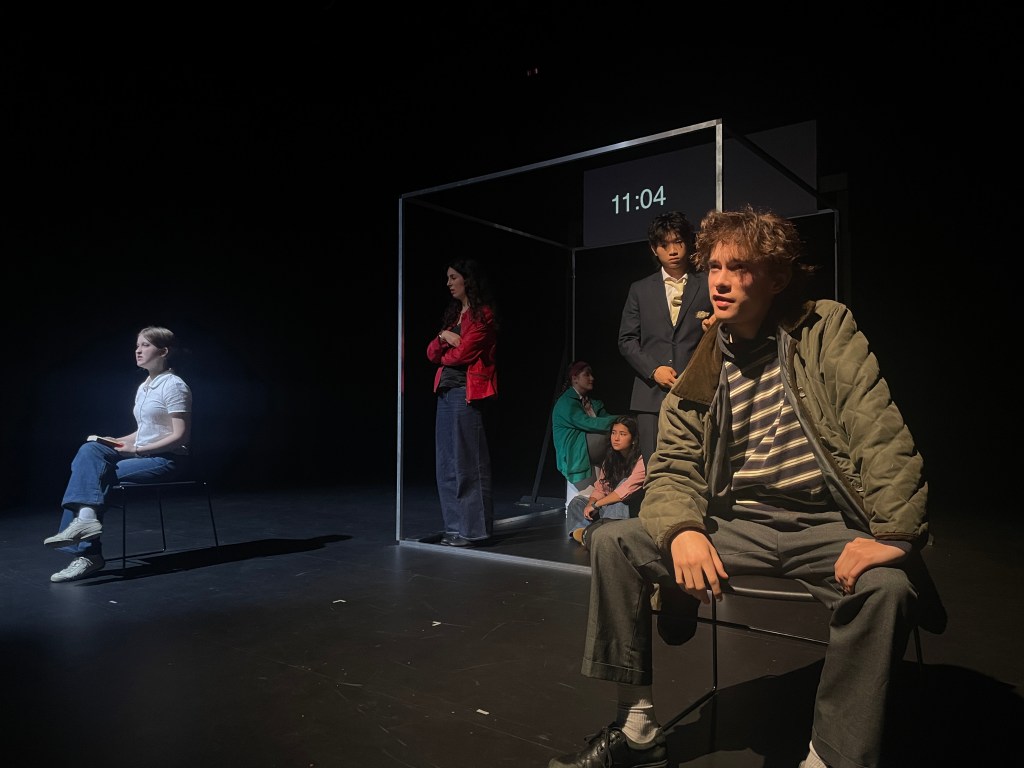
As each character gradually enters the lift to start their day, a plummeting sense of dread looms before the lift shudders to a halt, punctuated with bright accents of light before plunging the stage into darkness. The group panics initially, before a collective sense of boredom sets in as they wait to be rescued, in anticipation of an indefinite wait without signal or outside connection, in close proximity with a group of complete strangers.
Perfectly capturing the strains of a worn down relationship well past the expiry date, Juliet Bland and Zoe Barnett play Michelle and Mackenzie, bound for a hike that they’ll never quite get to. The emotional tension between the two was like a train crash you couldn’t look away from, furthered by the sensitive portrayals of a stagnant bond where both characters are deeply invested but know, deep down, it cannot continue any longer. In such an enclosed space, we begin to realise there is no other possibility other than explosion.
Michelle develops a bond with Alison, the only member of the elevator gang who doesn’t live or work within the building. After a night with a …friend, Alison’s embarrassed, yet sincere characterisation by Annie Hutchings becomes the glue for the eclectic group to bond. The heart of the character shines through in her rueful yet heartfelt reflection on the events leading to the night before, captivating in her earnestness. Each character felt truly plucked from the streets of Parkville, thanks to the work of Charlotte Henderson (Hair, Makeup and Costuming) capturing all the minute details right down to a simple carabiner.
Sunday, played by Isabel D’Souza, is a character written with such tangibly acute sensitivity for strained familial relationships, further complicated with the burden of personal faith in a religious household. D’Souza’s portrayal was a real standout, capturing Sunday’s tumultuous internal conflict authentically, and bumping heads with Frank ever so slightly in her gentle parenting of his unaware charisma. Everyone knows a Frank (David Wan), a man taking up slightly too much space because he’s never had to question his existence within it. Wan’s frenetic physicality within the confined space, in combination with his nonchalant arrogance, brings tension to their interactions with all the other characters in a way that allows the drama to beautifully simmer to the boil.
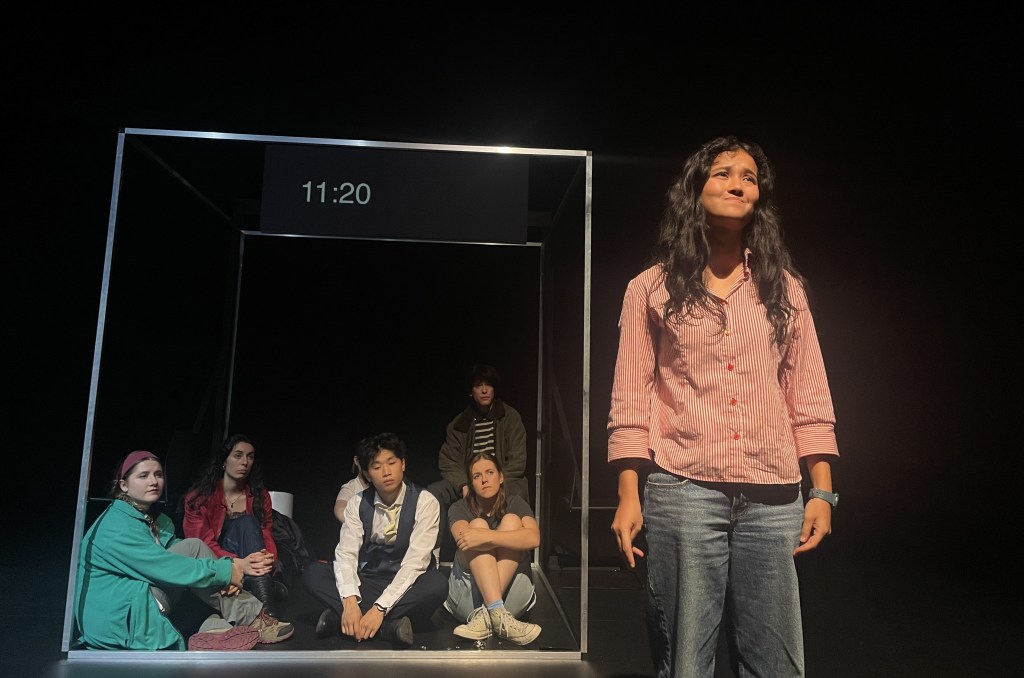
The barebones set (designed by Freya Taylor) practically represents the physically minimised space of the elevator; within the intimacy of the Guild Theatre, we grow to feel as though we too are trapped in the lift. The real beauty of Walsh-Davis’s carefully crafted piece is the limitation of space in the setting of the elevator. In taking an ordinarily mundane environment of a plainly scaffolded lift and tightly focusing the dramatic framing even further through the restrictive shadowy lighting, the considered staging becomes elevated through the constriction despite the occasional lack of face light. The unexpected blocking, movement and action within the confined space enables each character’s story to blossom through the closer attention to the story’s presentation from the company, and in turn, the audience become totally engaged, a true testament to Walsh-Davis’s direction.

Co-designers Oscar Lanigan and Emma Parfitt’s lighting shifting from warm to cool tone added texture to the otherwise shadowy emergency lighting within the lift. Focus was drawn to certain areas of the 2x2m cube as certain characters had their moments of shared emotion out of earshot. This became particularly resonant in featured moments of monologue, when individuals’ raw vulnerability burst through, marking the only movement outside the elevator during the production in direct confrontational address.
Sound, designed by Esther Luk, featured both infuriatingly peaceful elevator music, and warped time shifting motifs. The technical execution of all production elements was succinct, and felt effortless amongst the story’s staging; smooth and flawless are two words that come to mind when describing the technical operation of the show. Led by stage management team Tom Diggle and Mabel Sward (ASM), each cue was precisely timed in highly complex sequences, particularly at the start of the piece.
The incorporation of projection designed by Emma Parfitt was also incredibly impressive, indicating the lift’s levels, direction of travel, and the time. Having a working timepiece on stage that realistically runs minute for minute is always a challenge in potentially disrupting an audience’s suspension of disbelief and their attention to the theatrical experience outside the realms of experienced time. However, this feature never overpowered the story and instead functioned to precisely capture the tedious nature of being bored, completely stuck, and cut off from the world. If anything, it highlighted the fantastic pacing of Walsh-Davis’s script, and the power felt by the cast to comfortably ruminate within the uncomfortable silence, without it ever becoming too painfully awkward.

Stillness can be uncomfortable as an audience member, but it feels vital in Everyday, in allowing connection to ferment and grow in the stasis. It’s an all too painful reminder to pause in the hustle and bustle that is everyday, else we miss the revelations of truth, and important friendships forged in the reprieve.
Everyday creates space for reflection upon chaotic change, unexpected stasis, and the resulting powerful human connection that beckons and calls. It nails the hallmark simple charm of student theatre done well, the perfect balance of awkwardly hilarious and sensitively impactful. It was a joy to watch as the story came to life, and it is beyond impressive to have sold out the season in advance of the company’s opening night – this precisely nuanced and finely woven work is not to be forgotten quickly from our student theatre landscape!
Eleven Eleven Theatre’s Everyday by Avi Walsh-David played May 15th-17th at the Guild Theatre.
ANNA RYLEY is a second year Bachelor of Arts student majoring in English and Theatre Studies. When she’s not working on student theatre, you can find her with her camera, or working towards reading 100 books in a year.
AUDREY MCKENZIE (she/her) is a second-year creative writing major with a passion for student media and a good story. Alongside sub-editing for The Dialog, you can find her work in Farrago, Kill Your Darlings, and The Age.
The Dialog is supported by Union House Theatre.
 The Dialog