

REVIEW BY AZMY AZURITE
EDITED BY AUDREY MCKENZIE
Medusa may have been blindfolded yet I left the theatre gagged.
Medusa sheds light on the horror of being a woman in an age of gendered violence, recontextualising a famous Greek myth in such a way that it reverberated down to my bone marrow.
This is the third production by Four Letter Word Theatre that I have seen, and they continue to draw me in with their attention to detail and the incredible range of their productions. From music, to mafia, to myth, Four Letter Word Theatre will never miss.
The decision to focus on the women of the story genuinely expanded my mind—modern retellings of Medusa are often reduced to Medusa vs. evil men, yet Brontë Lemaire’s writing and directing allowed for a spotlight on Athena’s priestesses, and therefore a more nuanced discussion on gender and power.
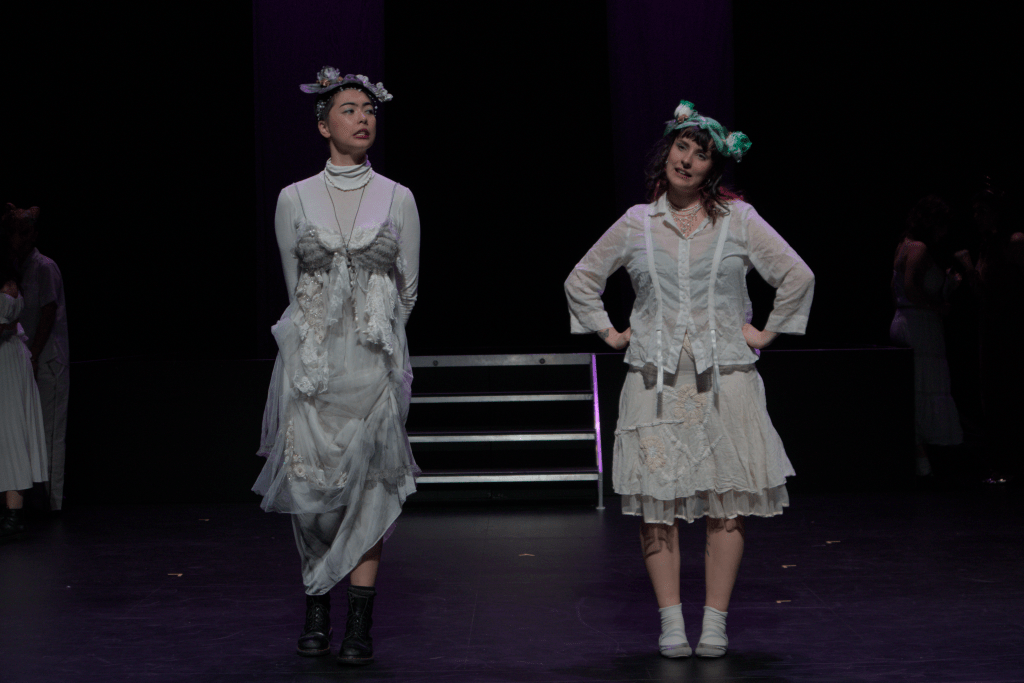
The priestesses are led by Medusa (Ruby Grinter), Thoosa (Jacinta Klassen), and Stheno (Jaimi Sfetcopoulos). Behind them are the triplets Deino (Katinka Schmid), Pemphredo (Mya Helou) and Enyo (Belle White) who tend to get nothing done because they’re busy being the funniest trio alive. The youngest and newest priestess is Eurayle (Harper Tierney-Hunt), who struggles to find her place in the priestess’ busy dynamic.

In the first half of the show, these women are depicted with a hilarious and playful family bond. The audience was laughing, I was laughing, and we all laughed so much that we almost forgot the tragedy of Medusa’s myth. The priestesses bickering and speaking over one another was one of my favourite parts of the production. It really felt like I was in the presence of an energetic group of sisters.
Tierney-Hunt’s portrayal of Eurayle was so full of empathy, her interpretation of the character’s childlike attributes was fun to watch, hilarious and tragic at times. Watching from the audience all I wanted to do was reach out and help her.
Schmid, Helou, and White play off each other energetically, creating a busy and exciting soundscape of overlapping dialogue. Moreover, Klassen’s portrayal of Thoosa’s turmoil—being pulled between two useless gods—and their depiction of Thoosa’s agonising desire to uncover the truth resonated with a relatable desperation.
Jakob Schuster’s electric sounds created a sharp contrast to the mythical setting, firmly setting the play in an exciting modern soundscape, with a tension that crawls into your veins and keeps you on the edge of your seat. Allira Smith’s lighting design provided a brilliant layer to the performance, elevating without detracting. This was particularly noticeable in the strobing scenes, in which the lighting added so much to the tension.
FLWT’s choreography is a consistent stunner. Intense battles and training were brought to life viscerally by Zani Micallef’s fight direction. The danger was palpable, as thick as the supposed snakes on Medusa’s head. When characters were injured, it felt painful just spectating.
The costuming and clothing symbolism headed by Eden McLean had me shocked in multiple ways. Watching sweet Perseus (Teige Cordiner) slowly lose the multitude of colour from his outfit as he is infected with Poseidon’s (Finn Corr) violent toxic masculinity, building up to Perseus in (mostly) all-black, donning the jacket that Poseidon wore to the festival? Absolute chef’s kiss. Genuinely insane.
Corr continuously does a fantastic job at playing wicked characters. His portrayal of Poseidon was disgustingly good—he takes up the stage with Poseidon’s cruel ideologies, festering and growing, infecting Perseus. Cordiner acts this character development skilfully as Perseus goes from genteel and unassuming to cruel and misogynistic.

The ox, designed by Lauren Kemp, was a haunting visual metaphor representing the violence enacted against Medusa. The meaning conveyed in silent scenes where the ox took centre stage was so thick, so thoughtfully done that the ox felt real, and I looked into its large gentle eyes and felt so much grief for everything it represented.
Charlene Yong’s prop and set design was gorgeous: the use of mirrors and the dynamics of the mirror symbol was incredibly done. Mirrors became doors, walls, hiding places, columns requiring upkeep. Mirrors in theatre are so hard to do as there’s the concern of the audience being reflected, but the type of mirror was chosen perfectly, blurred just enough that the audience was never able to see themselves during the performance, yet we could always see the actors hauntingly reflected back at us. The same is to be said about the Aegis. Turning a shield into a mirror is no easy task, it ended up looking pretty damn cool.

The romance between Medusa and Stheno was absolutely gut-wrenching: the delivery of “do you think I stayed by you for something as kind as pity?!” by Sfetcopoulos is going to rattle around in my skull for eternity. Grinter and Sfetcopoulos play this romance beautifully, especially in the final scenes. The tension and love and desperation between them was palpable; they clung onto each other for dear life—and clinging was not enough.
Overall, Medusa is a captivating, thoughtful and provocative exploration of gender and power that resonates loudly from its ancient setting to the modern day. This is a necessary and profound retelling in an age of gendered violence.
The contrast between the mythic setting and direct confrontation with the themes being discussed is striking. Lemaire doesn’t shy away from creating raw and messy dialogue that actively parallels contemporary discourse regarding sexual abuse.

Medusa urges us to face the world around us critically and push back against the toxic masculinity that caused the play’s tragedy, and to interrogate the power we hold over other people and the power that is used to control us. It urges us to be active.
As the curtains close and house lights go up, a single mirror is left at the front of the stage, showing us our reflections. We are now implicated in Medusa’s story. What will we do next?
At the end of the first act, Medusa turns to us and asks, “what are you looking at?”
We have to give her a decent answer. We cannot limit ourselves to being voyeurs in her tragedy.
Four Letter Word Theatre’s Medusa played April 10th-12th at the Union Theatre.
AZMY AZURITE is a University of Melbourne student and reviewer for The Dialog.
AUDREY MCKENZIE (she/her) is a second-year creative writing major with a passion for student media and a good story. Alongside sub-editing for The Dialog, you can find her work in Farrago, Kill Your Darlings, and The Age.
The Dialog is supported by Union House Theatre.
 The Dialog