
Reviewed by: Bronte Lemaire
“Listen to your parents, they say. They aren’t here anymore. But I can still hear them.”
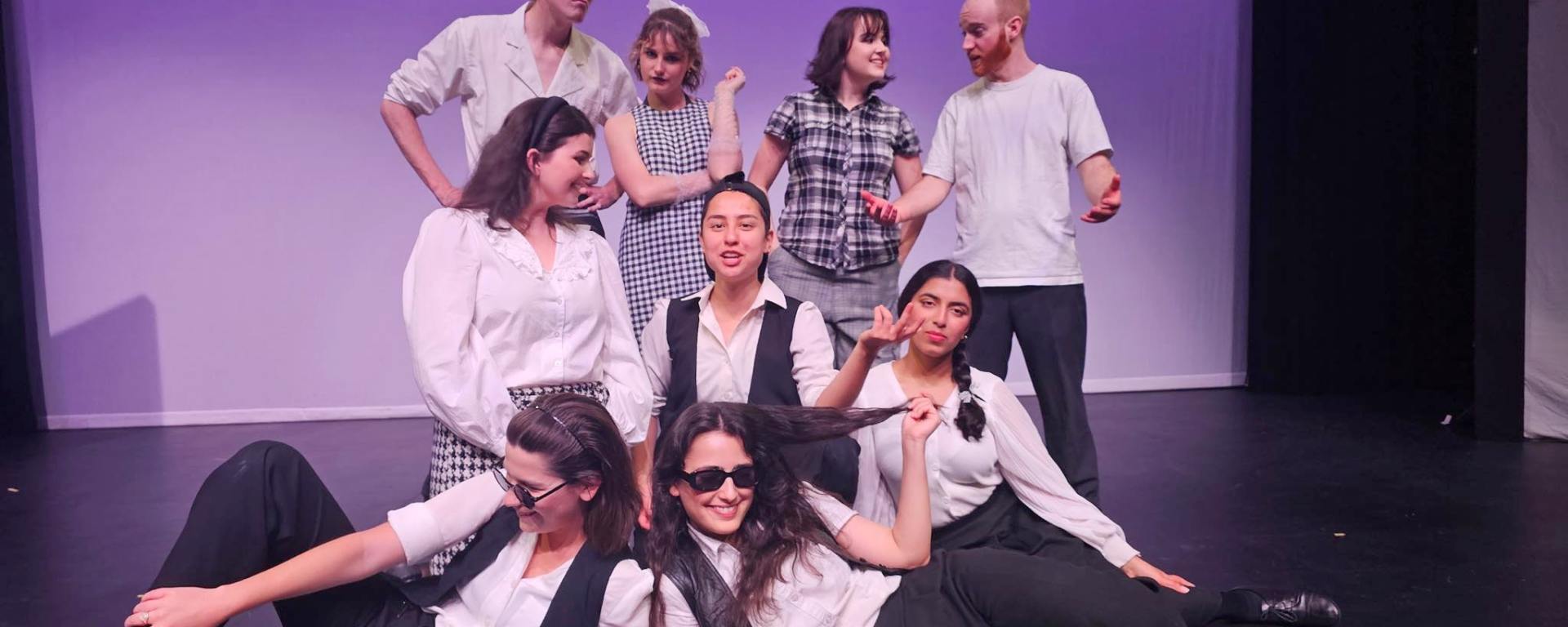
Table for One is a new play written and directed by Lana Rosalea, presented by Eleven Eleven Theatre. It follows five past lives of a soul: the haunting Gretta (Akshita Benny), who repeats the word “again”; the well-acclaimed but repressed actress and writer, Grace (Lauren Green); Jamie (Jim Bradshaw), a harsh and antisocial man; Celine (Emma-Lee Bonnin), an incredibly anxious woman and Parker (Lou Martin), the chaotic and newest past life. Gathered to have a meal curated by the afterlife staff (Gryff Connah, Justine Hobeiche, Mikaela Cummins and Tinka Schmid), we find out that each time a soul dies all the past lives must have a meal together. A few have obviously been through this before, like Grace and Jamie who want it over as quickly as possible, but Parker endeavours to find out a deeper meaning in this gathering and why they keep getting served courses with strongly associated memories.

The actors did brilliantly, well equipped with Rosalea’s conversational script. They spoke over each other in a realistic cadence, and were each able to manipulate their stage presence to take turns centering themselves in the scene, working together as a developing unit. There are a few particular standouts amongst the strong cast, first being Lou Martin who played Parker. Martin made Parker immediately likeable upon their entrance, showing the range of Parker who one minute was comically riling people (usually Jamie) up for the fun of it, and the next felt small and vulnerable under their mother’s omnipresence. And speaking of, Jim Bradshaw’s Jamie was a welcome contrast to the other characters, always pushing others away and refusing to share his memories in order to isolate himself from self-reflection. His tough facade that slowly dropped away was a compelling arc to follow. A comedic highlight was Gryff Connah who played the afterlife chef with a curled-over gait to match his simplistic gruff speaking, who in one scene gave us a rather racy mopping show.
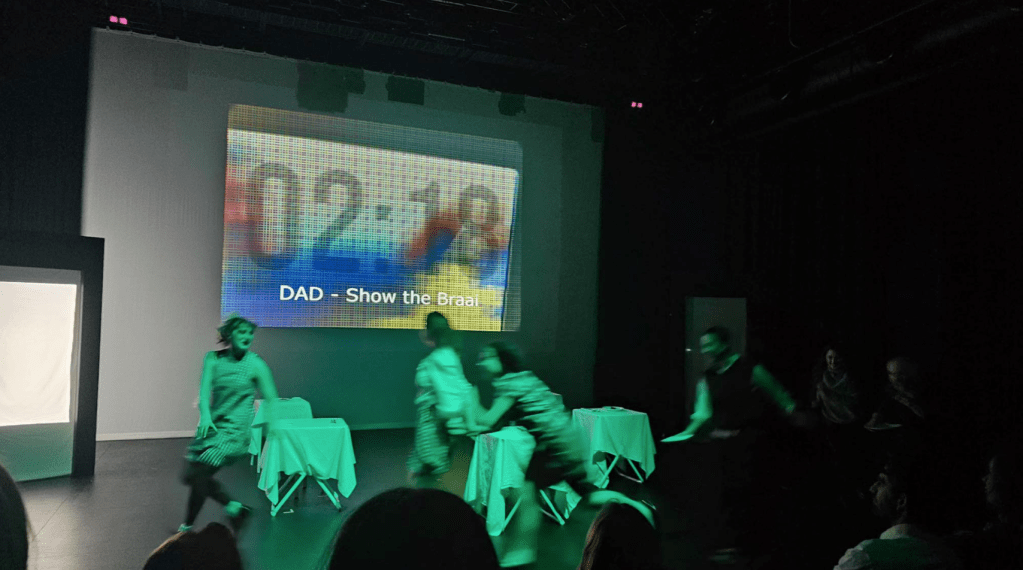
Praise must be given to the stunning multimedia employed throughout the show created by Vincent De Guzman’s sound design and Ami Salinas’ animation. Every time memories of a past life were shown, they were presented through videos projected above the stage, each unique and catered to the character in question. Some were abstract animations to situate us in an uncomfortable atmosphere such as when delving into Parker’s relationship with food and body image. Others were flashing montages to get us stressed alongside Celine’s younger self in an exam, bombarding us with rapidly changing images and the inescapable sound of the ticking clock.
My favourite was Jamie’s memory, a one-take, black and white video. It showed Jamie and his brother at the graveyard discussing their parents and how each interpreted their childhoods differently. The video only showed the back of their heads, keeping their expressions private while allowing us in on the discussion through captions. It was entirely silent, with the characters gathered together in a clump underneath and unmoving, but the audience’s attention didn’t waver, creating a needed moment of stillness and reflection.
The multimedia really highlighted how production areas had clearly been thought out holistically. The grayscale costumes by Charlotte Vella, which made the past lives appear ghostly, were heightened by the bold colours on the cyclorama that lit up the stage. The lighting by Andrew Thomson was able to be fully utilised through the set created by Mary Scho as on each side of the stage sat a door frame with white fabric stretched across it. When light shone through the back of them, the actors were able to do shadow work, giving us an otherworldly way to experience Grace’s memories. The actors were also able to interact with the set in a ritualistic way. Each time a course was served, the five small dining tables were manoeuvred into a new formation, often to highlight one character to explore, as well as create hideaways for the character Gretta to disappear underneath.
As much as I enjoyed the show, I do wish the staff scenes fit more neatly into the greater vision of the play. The staff seemed to be serving as the comedic relief of the show, but because the past lives were already funny themselves, it was sometimes a strange tonal transition. It would have been nice to see their struggles be folded into the themes of the shaping of identity parents take part in, even if it wasn’t central as it was for the past lives.
Table for One pulled off the magnificent feat of having symbiotic production elements that fed and aided each other, letting the actors and writing really shine. This show reminded us that parents need to be careful about raising children and whether they’re pushing them in the direction they need, or just into the mould of their own image.
Table For One played October 17th-19th 2024 at the Guild Theatre.
The Dialog is supported by Union House Theatre.
 The Dialog