

Reviewed by: Simon Brownjohn
Ormond Drama’s rendition of Spring Awakening took the 21st century classic to the Union Theatre in an enthralling performance of rock and sadness. The show presents the lives of adolescents, each of whom uniquely come to terms with their burgeoning feelings of sexuality, against the backdrop of a repressive environment which shuns the characters into silence. The themes discussed encompass topics relevant to present-day society, including domestic violence, suicide, and sexual expression. It is important to handle these themes tactfully, and from my perspective, Ormond Drama accomplished this. At the core of Spring
Awakening lies a dissonance between its upbeat anthems (e.g., ‘The Bitch of Living’, ‘Totally Fucked’) and the poignant topics these songs discuss. Ormond Drama handled this juxtaposition with finesse; the ensemble’s emotional intensity interacted with vibrant lighting choices and a strong performance from the band formed a satisfying theatrical concoction.
The show’s music was compelling, I was impressed with how well the band gelled with the actors’ singing; this was particularly palpable in the especially contemporary songs, namely ‘Totally Fucked.’ My favourite song from the performance was ‘Don’t Do Sadness/Blue Wind’, a duet between Ilse (Nathalie Wilder) and Moritz (Jasper McConaghy), which serves as an emotional climax prior to the Moritz’ suicide. Wilder’s singing was deeply moving and channelled the tragedy of these two characters. The contrast between her voice’s calmness and the McConaghy’s freneticism worked exceptionally well.

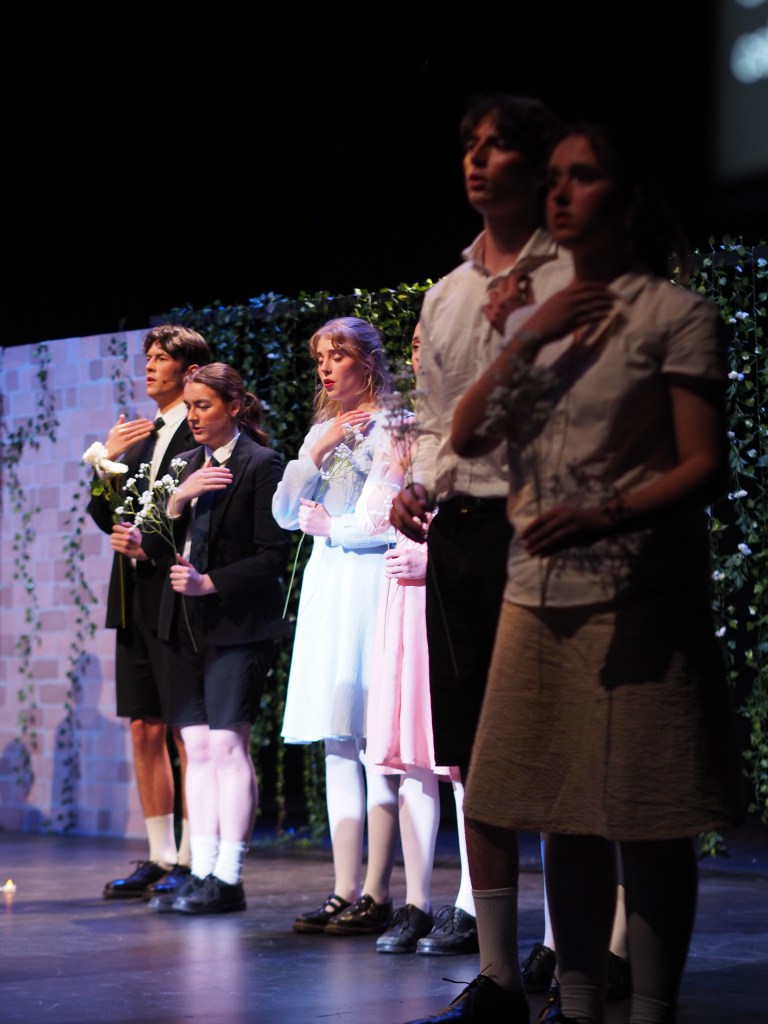

I derived greater enjoyment from the show’s second act than I did the first. From an outsiders’ perspective it felt like the cast devoted a majority of their rehearsal time to perfecting the grand moments on display in the latter half of the show. Ormond Drama did a wonderful job of making the show accessible through the use of an accurate subtitle screen on the side of the stage. This is particularly important given Spring Awakening’s history – the show has received cultural recognition for performances featuring deaf actors using sign language. I spent more time looking at the subtitle screen than I had anticipated. The show understandably requires some degree of exposition to immerse its audiences in the unfamiliar 1890s German setting – adorned by the names of esoteric Latin philosophers frequently referenced throughout the show. Unfortunately, there were instances in the first act in which I couldn’t make out certain lines, whether due to my unfamiliarity with the idiosyncrasies of the setting or otherwise. I found myself quickly glancing at the screen before diverting my attention back to the stage, fearing that I would miss an important choreographic moment. These kinds of thoughts unfortunately disrupted my immersion from the show. It’s worth noting that whilst I was completely unfamiliar with Spring Awakening prior to watching Ormond Drama’s performance, my friend in the audience knew the show back-to-front and did not echo my experience regarding this. Nonetheless, one way this could be overcome for future shows would be a greater emphasis on diction and projection during rehearsals. Skip Pieper, who played Melchior Gabor, the show’s rebellious protagonist, excelled at this; he brought a firmness fitting of Melchior’s character in each line delivery.
As a whole, the cast of Ormond hit every emotional beat flawlessly; I cried at a scene during which Melchior kneels at the grave of his lover, Wendla Bergmann (Zoe Meiers), who then appears behind a set window, alongside Moritz Stiefel (Jasper McConaghy), Melchior’s best friend who took his own life earlier in the show. The show’s choreography (Kelly Nickson) and set design (Blake Wright, Madison Webster) allowed grand moments like these to truly shine in the Union. The set wasn’t overly complicated, and nor did it need to be. The primary set piece appeared to be a cathedral wall, which helped cement the conservative social structures the characters battle with at the forefront of the audiences’ minds. The entire cast brought a remarkable emotional intensity to their performances, and it is evident that the directors (Issy Campbell, Eleanor Hargreaves Marr, Scarlett McLellan) and actors shared a clear vision. This resulted in strong characterisations which, for me, were the show’s greatest strength. Even the minor characters were resonant; the frigid abortionist Schmidt (Oli Craig) sent a chill down my spine and left a harrowing impact, despite appearing in just two scenes.
Ormond Drama’s performance of Spring Awakening felt inspired. All the different aspects of the show came together in a theatrical tapestry which felt lucid, fun, and emotionally charged.
Spring Awakening played at the Union Theatre from August 17th-19th, 2023.
 The Dialog