
By Tian Nie
Content warning: This review mentions suicide and rape.
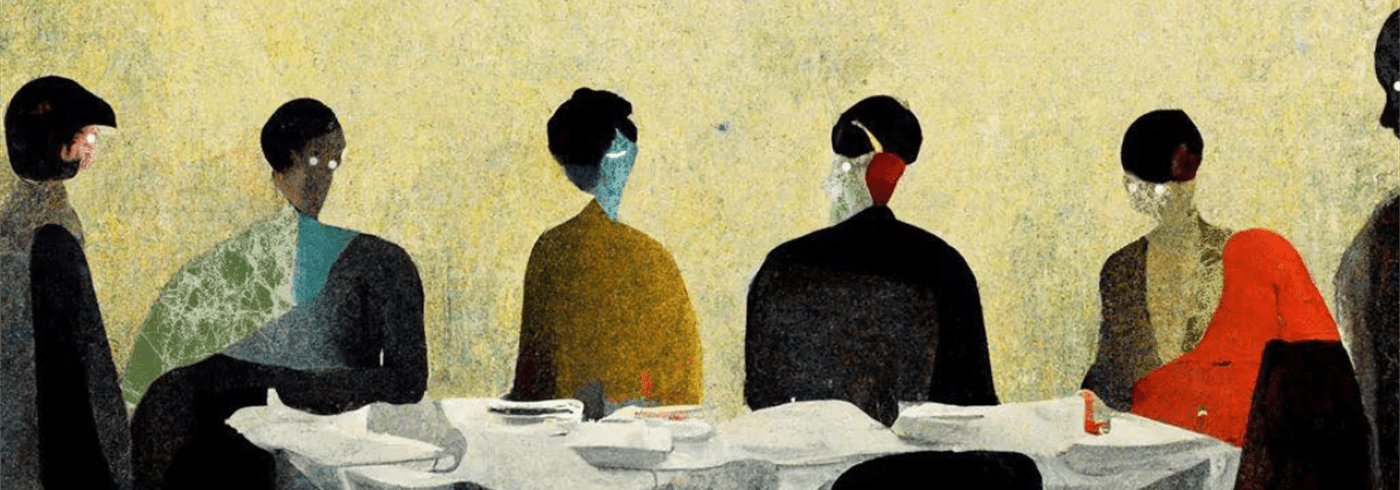
Can you picture yourself without a camera phone? Or, worse, can you imagine your phone on display to your friends, revealing every spicy selfie, sensitive medical appointment and spam calls that are definitely not your side-chick trying to tell you that she’s pregnant? That is the premise behind Melbourne University Chinese Theatre Group’s (MUCTG) production Kill Mobile (来电狂响). The play adapts the Chinese movie of the same name directed by Yu Miao, which is itself an adaptation of the popular Italian movie Perfect Strangers (Perfetti Sconosciuti) by Paolo Genovese. A group of seven friends—three couples and a single woman—with seemingly peaceful lives gather for a nice dinner. Except nothing is quite as it seems, and chaos ensues. The emotional roller coaster—produced by Chen Xiangyu, Tian Chenkai and Dai Chengyan, and directed by Shawn Shi and Tian Chenkai—may end on somewhat of a tame and unsatisfying ending, but the 90 minutes of pure theatre magic was thrilling to watch.
The play opens with Han Xiao (played by Yao Yuqing) standing on a ledge—literally. Right as she is about to step off into the void, her phone dings with a text: When are you coming to dinner? She steps off and thus the production’s tone and high quality is set: precisely timed lighting and media displays, sound that convey hard to replicate environments and a potential tragedy, averted by the timely intervention of a notification.
At the house—the site of the ill-fated dinner party—each of the three couples have their issues. Professor Wenbo (Sun Ranran) and psychologist Daidai (Zhang Zuobin) don’t talk to each other much. Wu Xiaojiang (Dai Xingbang) and Li Nan (Shao Yeyi) seem the perfect businessman-housewife couple, but both are seeking attention from strangers on the internet. Jia Di (Tian Chenkai), the broke artist and playboy, finally snags an 18-year-old sugar mama to fund his scriptwriting career, only to have his side-chick and counterfeit jewellery dealer threaten to expose him. And the sugar mama Bai Xuejiao (Zheng Wei)? Well, she’s just coming along for a ride in her white Maserati. No one is who they seem. Throw in some free psychoanalysis from the resident psychologist, misunderstood texts from an ex, and phone switching, and we have the recipe for a debacle leading to ruination for four out of the seven people present. Surviving the fallout might require looking up from their phones, if they dare.
The witty dialogue and acting was tight. Dai and Shao portray a believable couple who in the end after all the shouting and fighting still love each other, a credit to both actors given the difficult script. Tian’s wild, physical outbursts of anger were equal parts appropriate, over the top, and concerning. Zheng’s portrayal of the vapid, barely-legal little white rabbit was toothrottingly sweet. Sun and Zhang had great physical acting, even as they were written more as space fillers than developed characters. Han Xiao arguably had to go through the most amount of character development with the least amount of dialogue, but Yao did a convincing job conveying the metamorphosis of a suicidal rape victim to a confident woman willing to face her rapist in court. I would have enjoyed it if she had had more lines to develop her character further.
The dénouement, too, is lacklustre with little room for character growth. It’s revealed that the party members are acting as a strange fantasy version of themselves in a play within a play. The couples are still together (with vastly different personalities and accents) and the bachelorette is blandly happy, as if the play we saw was meaningless. Phones—previously the most potent force for social destruction in the play—are suddenly positive tools again. These hypothetical endings are difficult to pull off and require good writing to make meaning out of them, but like the sudden monologues pulled out of the void and inexplicable character growths, these deficits may be attributed to poor source material—not MUCTG themselves.
That said, the show was a spectacle of excellent backstage work.
The costumes and makeup (Wang Zhe) were simple but effective, distinct whilst not being distracting. It was clear from a glance which of the men is a professor (with a white sweater over the shoulders), an average middle-aged Chinese guy (my uncles own the same yellow plaid getup) and a broke playboy artist (wild hair, leather jacket, ripped jeans—need I say more?). The women each matched their partners in either colour or material, with a white dress, yellow dress and red leather jacket respectively. The suicidal Han was pure black and dressed like a stage-hand—and, like a stage-hand, she fades into the background before coming out at crucial moments. The only costume change was the divorced wife’s sexy black revenge dress, but some other basic costume changes (like taking off a leather jacket during the playboy’s decision to commit to monogamy) could have worked to convey character growth.
The ten-person set and props team led by He Xinyu created a simple yet complex environment for the actors to interact in. Actual prop items were used throughout the show, including a barbeque pit and sugar glass wine bottle. The set design (Shi Qian) effectively sectioned off the areas of importance within the house while making sure most of the action could be seen.
The lighting design (Wang Ziyue) effectively drew attention in scenes where there were multiple sequences happening at once. There were lightning-fast switches during concurrent dialogue whipping between the women on the left and the men on the right, which functioned like the works of a camera guiding the audience to the action. The phones themselves were placed on selfie-ring pedestals, changing colour with each notification, which was an innovative piece of theatrical engineering. The notifications were also projected onto the big screen operated by Huang Jinghao and Xin Zhirui, allowing the audience to see every scandalous text. At times, it even felt like we were part of the picture-taking action with the flashing paparazzi lights.
An extra shout out goes out to the seven-person (seven!) sound design team led by Zheng Jiajie, whose efforts clearly paid off. The soundscape was immersive, balanced perfectly against the actions on stage. Perfectly timed invisible doors opened and closed. Tumultuous music enhanced dramatic effect and added to the emotional turmoil. The house music—both literal in the sense that it was the music as the audience walked in, and the music in the host’s house—was composed by assistant sound designer Wendy Wang and recorded at UniMelb’s Southbank facilities. It sets the mood for a sophisticated couple tinged with melancholy, setting up the reveal of the professor and psychologist in the process of divorce. The mics, too, were extremely well-controlled and unnoticeable, to the point I didn’t initially realise the actors were wearing them.
As a Chinese show with English subtitles, the translation team led by Ming Qiuchi did an excellent job of localizing and contextualizing the rapid-fire dialogue. Word puns like pi (屁, meaning fart) were translated to pee puns, keeping much of the same humour. Some segments were more difficult to localize, such as the sudden accent switching to what I think might be Sichuanese or the actors’ local dialects towards the end. I imagine the differences for non-Mandarin listeners were subtle, but for myself it was like hearing a rural bogan accent after an hour of the poshest private school accents. It made the plot twist both funnier and more believable, as most locals wouldn’t be speaking standard Mandarin to their close friends and family.
As an aside, I also appreciate MUCTG taking my previous criticisms about their English marketing and show program into account. The English marketing was leagues more obvious than last semester, and the physical ticket to the show performed double duty as a program as well. The actor interviews in both the English and Chinese marketing online, however, showed more character depth that was displayed in the actual show. It would have been more effective if such the characters conveyed on instagram aligned with those in performance as well.
MUCTG’s Kill Mobile was a pleasure to watch, with exceptional performances both in front and behind the curtains. I do indeed feel called out by the final monologue for immediately going to the bathroom after the show and looking at my phone. But hey, at least I wasn’t hurriedly deleting my text messages from the cam girl I like!
MUCTG’s Kill Mobile ran October 20th to 22nd at Union House Theatre.
Tian Nie (she/her) is a PhD student in biomedical research in Naarm/Melbourne who dabbles in music-making and theatregoing in her spare time.
 The Dialog