
By Soph Fitzgerald
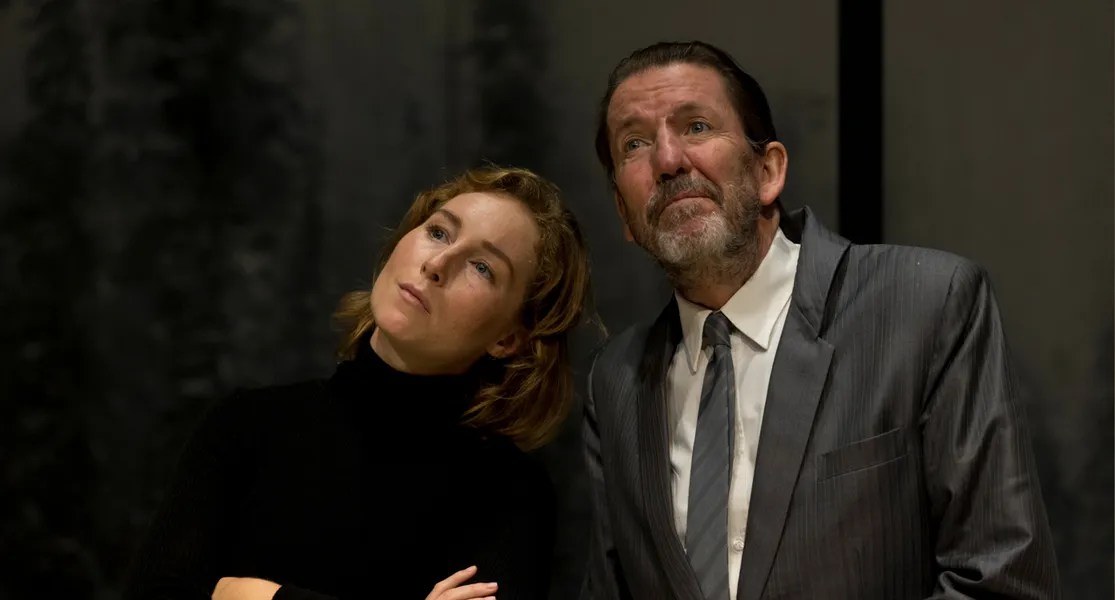
Performed at the Arts Centre Melbourne, Peter Evan’s’ Hamlet (2022) unfolded beneath a soft rain of artificial snow, dusting the court of Denmark with an unshakable frostiness. Bell Shakespeare, loved by critics and laymen alike, has long been lauded for their well-acted portrayals of the bard’s greatest hits. This production, starring masterful Harriet Gordon-Anderson as Hamlet, continues the 300-year-old tradition of women playing the Danish Prince, which began with Charlotte Clark’s London Performance in the early eighteenth century. Gordon-Anderson advances this legacy with a delightful performance, energetic and melancholy in equal turns. Her Hamlet is tactile, funny and bitter, strutting around Anna Tregloan’s set.
Tregloan’s design is brilliant, both simple and creative. A white shag pile carpet covers the entire stage, demarcating a snowy ground. A metal frame encloses a Persian rug, modish seats and a drinks trolley, serving as the royal family’s living room. Curiously, indoors and outdoors were not strictly enforced; characters crossed the domestic threshold during scenes unfolding outside in the frosty Denmark grounds. The snow was similarly undiscerning, falling atop the characters as they sat indoors. The stage is encompassed by large white walls adorned with the snowy Danish forest. The inescapable barren whiteness of the set gives rise to both claustrophobia and emptiness. All these elements fine-tune a truly frigid atmosphere.
By all means, this production was extremely well-acted. All cast members were completely at home on the stage and with the bard’s heavy prose on their lips. Robert Menzies’ Polonius was a clear fan favourite, more of a tithering old father than a conniving politician, ultimately making his death more emotionally charged than the rest. And again, it would have been worth seeing the play just to watch Gordon-Anderson, whose timeless soliloquies were delivered directly to the audience with intimacy and vigor. It is a hard thing to make such well known lines land with conviction, but this Hamlet announced them with striking sorrow.
A female-identifying person playing a distinctly male role was a clever choice that highlighted the violence of Hamlet’s worlds. There was a particular bitter frigidity in Gordon-Anderson’s Hamlet locking everyone—save Horatio, played by Jacob Warner—from his heart; especially Ophelia (Rose Riley), whom he claims to love, but treats with visceral contempt. Actor and director have perhaps considered the implications of the twenty-first century’s epidemic of angry young men, the incels and self-proclaimed nice guys. Hamlet, like many similarly privileged, well- educated young men, uses one perceived betrayal from a woman close to him to punish the whole “frail” sex.
And yet, this was a production lacking in heat. The relationships between the actors were as frosty as the settings. Ophelia and Hamlet’s chemistry was unremarkable, as was Gertrude (Lucy Bell) and Claudius’ (Ray Chong Nee). The Danish prince’s bond between his college friends (played by Jane Mahady and Jeremi Campese) was more believable, but lacking the familiar poignancy that makes their betrayal sting. Hamlet’s interactions with the women in his life were more physically violent, seemingly by virtue of having a female actor. Gordon-Anderson grabs or drags both Riley and his mother Bell at times, a roughness uncomfortable to view coming from our mostly sympathetic hero, who, most often in solitude and when not interacting with these women, is portrayed as particularly emotional and sensitive.
Even Horatio, Hamlet’s most esteemed companion, seemed a superfluous observer in this production. Warner studied the audience as they take their seats before the production and lurks in the background of scenes, watching, but often not taking an active role. Warner played this part with ease; his intense gazing and considering looks and replies were sincere. While it seems clear that Evan’s intended Horatio to be the watcher and act as a stand-in for the audience, it was unclear—to me—what dramatic meaning he intended to be parsed from this. Instead, the production felt a character down. The famous chemistry between the two characters was most egregiously missing, and though some tenderness remained, Horatio was cheated of his parting lines to his “sweet prince”.
The choice to stage this production in the sixties felt underbaked, serving only the aesthetics of the set and Ophelia’s lemon-yellow costume, with the rest of the cohort in ambiguous suits or dresses. With such a skilled costuming team (headed by Sara Kolijn, supervised by Sally-Anne Andrews and assisted by Valerie Adele), the choice to dress most characters in unremarkable attire felt like a wasted opportunity. Scenes in which the characters comment on the dirt on each other’s ruffles and stockings thus felt awkward. Perhaps the most subtle but sparkling use were the mirrored costumes of Gertrude and Ophelia at Ophelia’s burial, where both were clad in virginal white coats. However, no dialogue nor political incident was inserted to give the sixties setting any further meaning or purpose, so it simply felt like an easy revamp option.
The sound (Max Lyandvert) and lighting design (Benjamin Cisterne) were subtle and served to enhance the stage and acting without drawing too much attention to themselves. I was dreading sixties hits between interludes, but instead I was met with haunting instrumentals. While artistically lovely, the videos (designed by Laura Turner) of Hamlet (both as a child and how he appeared on stage), Ophelia and Gertrude projected onto the walls felt lacking. These saccharine home videos felt out of place and subsidiary, adding little to the overall performance. It seemed like the director was attempting to insert these gentler memories to circumvent the lack of tenderness present on stage, yet it was so at odds with the overall production that it resonated to me as nothing more than a forgettable trend.
Hamlet was far from mad; grieving, bitter, sardonically funny and vicious—he was by far the most lively thing on stage. The staging was cleverly crafted and the acting professional. And yet, the featured quote for this production—”this Hamlet is special”—falls flat. This Hamlet was not especially unique: it was a well-acted, very well-received retelling that did not change and re-interpret much. If feels as though Bell Shakespeare has played it safe, almost too safe; far from an adaptation that may stir a vestige of controversy. I am reminded of the Sydney Theatre Company’s Macbeth (2014) where the audience were crammed on metal benches onstage—an infamously contentious but nonetheless landmark production. One is left wondering what might have been if the creative and professional prowess of Evan’s’ Hamlet was put to the test, instead of tasked with simply delivering an excellent piece of theatre seen countless times. It is interesting to note that my friend and I, at twenty, were by far some of the youngest audience members; getting shushed in act two and offered free ice cream during the interval.
This Hamlet was good, brilliant even, but it was not radical. What could have been if this frosty piece of theatre was thawed? What worlds live beneath the centuries old ice, waiting to be discovered?
Bell Shakespeare’s Hamlet ran in Melbourne from March 4th to May 14th 2022 at the Arts Centre Melbourne.
 The Dialog