
By Tian Nie
After years of online shows and activities, the Melbourne University Chinese Theatre Group (MUCTG) returned with a highly anticipated bang. How high? How about the “selling out closing night in five hours” kind of high.
The Hostage (你好打劫, literally: hello robbery) is a black comedy drama written by Xiaozhi Rao based on the 1975 film Dog Day Afternoon, which itself is based on the real-life robbery of a New York City bank in 1972. This 2022 production—produced by Xiangyu Chen, Shihan Kou and Wenhao Li, and directed by Rongcheng Wei, Xinyu Song, Xinuan Wang and Yueqiao Min—takes a feminist spin on what is typically a male-dominated world of violence and desperation. Utilizing every sound, light and detail at their disposal, MUCTG asks the audience: what is freedom under capitalism, when you have no other choice?
The four-act play takes part in one bank building on a regular weekday afternoon. Two robbers come and hold four employees hostage, accidentally setting off the police alarm in progress. The police arrive and, and what is an increasingly policemanly manner, become the faceless external threat of violence to robber and hostage alike, while power struggles and character development rage within the bank windows.
Aside from the critiques of society and capitalism, there are also more subtle allusions to the original story. The script of The Hostage does away with the LGBTQIA+ identities featured in the film and original hostage situation. The real-life robber John Wojtowicz got the idea to rob a bank whilst frequenting a gay bar and wanted the funds to help his transgender wife transition. Instead, John’s in-script stand-in Sunny’s main motivation is to escape the crushing weight of capitalism. MUCTG’s gender-swapping of four of the five male characters in the original script from men to women adds in a more subtle element of exploring gender roles.

MUCTG has a strong history of tight knit ensemble casts, and this production was no different. Banter flowed smoothly between members and the chemistry was explosive—a C-4 ready to detonate at any hint of provocation. Dialogue was cleanly and emotionally delivered, even through hyperventilation. However, the tension tended to run a little too high too often and sometimes became exhausting to watch. The external conflicts between characters, coupled with the internal conflicts between what society dictates they should do and what they want to do, shone through the bank employees. Perhaps getting robbed is a different kind of spiritual freedom for these pawns of society.
The repressed bank manager Tom (Xingbang Dai) brought lightness and humour into each of his scenes, particularly impressive considering he is a first-time actor. It wouldn’t be remiss to say the room and mood literally brightened when he spoke. Employee and certified bootlicker Riddle’s two-faced self-preservation instincts were exquisitely unravelled by Sifan Wu. Her customer service smiles in the face of uncertain death were truly top notch, a relatable feeling to many in the service industry. Cassie Chenxi Li expertly portrayed the quiet, fearful, unpaid intern and literal pawn Cruise’s loss of identity and transformation into a fearless, short-tempered firecracker and queen of the chessboard. Icy, played by Nan Su, was a calm façade, holding the hostages together so she could hurry home for a dinner with her perfect husband. And if she happens to poison said husband during the meal, well, that’s on him.

The robbers, Sunny (Yufan Chen) and Sasha (Yi Rong), come out of the play as the least developed characters, despite being the driving force behind the plot. Sunny flips between a powerless angry anti-establishment citizen and a domineering director of fate. Her excessive tendency to monologue at the audience is an interesting choice; the hostages are too scared to call her out on it, but they must have wondered many times why the robber is talking to a wall. Sasha is also confusing—by her own admittance she had an average childhood, good parents and a decent (if mediocre) life. The plot may not have elaborated on her motives, but Rong convincingly pulled out the hidden depths of Sasha’s warmth in subtle ways, while projecting an air of ruthlessness. The faceless voice of the FBI is the most unchanging, much like the society it represents. It had an unsettlingly patronizing and apathetic tone, foreshadowing the ruthlessness in gunning down all but one escapee.
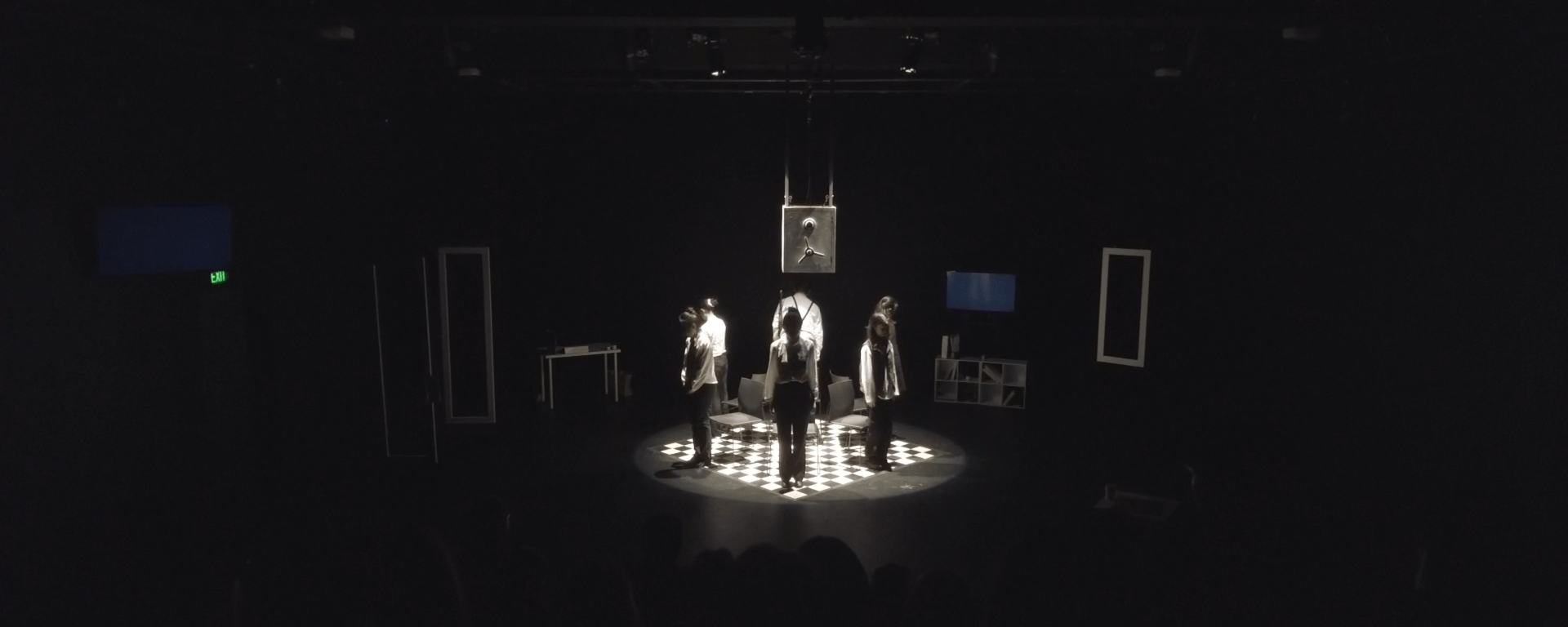
There were many strong technical elements in the production. The simple props and sets (led by Xinlan Huang and designed by Xinyu He) were exactly as needed. A gun was a gun, a phone was a phone and a bank vault opened via gunshot was a bank vault opened via gunshot. A smoke machine in conjunction with lighting provided an effective and stunning backdrop for yet another dramatic monologue. The bank vault looms like an industrial chandelier over the central checkerboard stage; a silent king overseeing its territory. There was also a literal chessboard in the foreground, permanently stuck in the middle of a game. Perhaps it’s an allusion to Shakespeare’s maxim of the world as a stage, with the characters as mere pieces pushed by unseen powers towards their fated end. The costumes, designed by Ziyang Lin and led by (Yuqing Xia (Serena)), furthered this narrative, with the employees functioning as the white chess pieces and the robbers as black.
Clever partitioning of the stage allowed for the lighting to shine through, placing dramatic emphases on hauntingly memorable tableaux. The Lighting Director Shawn Shi and Lighting Designer Wing Lam Chan (Vanessa) did a spectacular job of using every single light at their disposal. The dramatic red of the wedding scene particularly accentuated a lonely spotlight of despair, as if the lights are the marital chains holding Icy hostage. The sound design (led by Zhirui Xin (Ray)) was similarly fabulous, where classical music was used as a subtle yet precise representation of class to great dramatic effect. The gun shots were perfectly timed, speaking to the skills of the sound operators. Police sirens and news alerts added a layer of realism, as if the audience really is watching the robbery happen live.

As a native Mandarin speaker with an elementary-grade grasp of Mandarin, I highly appreciated the efforts of the translations team lead by Crystal So. They worked hard to translate 90 minutes of quickfire dialog into English and did a commendable job keeping true to the meaning and emotion of each scene. There were some minor errors, which are inevitable when the nuances of wordplay and cultural concepts do not directly translate.
My main criticism with the show might just be the English marketing—which is to say, there was little I could fault in the performance itself. Despite having extensive online WeChat marketing filled with high-quality interviews, intriguing video trailers and informative ticket sales information, not a single piece of ticketing information made it onto their English facing pages (their last Facebook update is from 2020). Seeing as MUCTG won ‘Most Outstanding Production’ for their completely Mandarin production of Kung-Fu Man in the UHT Awards in 2019, there is definitely a vested interest from the broader university community. Another marketing issue is that, despite beautifully designed posters and fun thematic tickets, there were no virtual or physical programs. Finding basic information like the names of the crew should not require trawling through month-old WeChat posts like an investigative journalist. A program would have been an easy way to acknowledge the efforts of everyone involved, not just those on stage, and would also serve as a nice memento for the audience to look back on.
Overall, MUCTG’s production of The Hostage is the culmination of years of audience anticipation and months of hard work. All the cast and crew from pre-production to final staging involved brought their A-game, providing the audience with a thrilling, high-octane escapade watching six misfits struggle to escape the symbolism of capitalism. It left me with a timeless critique of capitalism: the faux image of meritocracy, patriarchy, traditional expectations of women, police incompetency and violence, the role of media in truths and distortion, and how it all congeals into an unfortunately familiar society. And like the society we live in, the show offers no solutions to the problems facing us, only enlightenment and a sense of impending doom. Maybe I’ll go rob a bank later.
MUCTG’s The Hostage ran May 26th to 28th 2022 at the Guild Theatre where all four performances sold out.
 The Dialog