
By Lilah Shapiro
My first sentence must be dedicated to the writer and director duo, Laura Charlton and Sabina Donato, for taking on the behemoth that is Hamlet, and producing such a creative and radical adaptation. I commend their ambition and courage. For any newcomers, the general gist of Hamlet’s plot is that after his father the king dies, King Hamlet is replaced by his brother Claudius, who takes up with his deceased brother’s wife, Hamlet’s mother. Things really get going when the dead King’s ghost appears to Hamlet and reveals that it was his own brother who murdered him! He also bids Hamlet to revenge his death by killing Claudius. A lot of indecision and toil follows with the play ending in a dual in which both Hamlet and Claudius die.
There is a myriad of problems to navigate in performing modern Shakespeare. Hamlet has a reputation for being modern and timeless, but it is still a piece of sixteenth-century theatre. How can we make the language accessible? How can we alter themes which feel defunct—religiosity, revenge, the king as God, natural order—feel relevant? And, of course, how can we resolve problematic representations of femininity and masculinity?
The pre-show announcement which ushered in the performance implored the audience not to turn off their mobile phones, but to renounce the destructive colonial legacy of Shakespeare and instead “search for value” in our contemporary context. HAML3T argues that in order to “search for value”, no tradition is to be left unturned—a powerful case for the pillaging of Shakespeare.
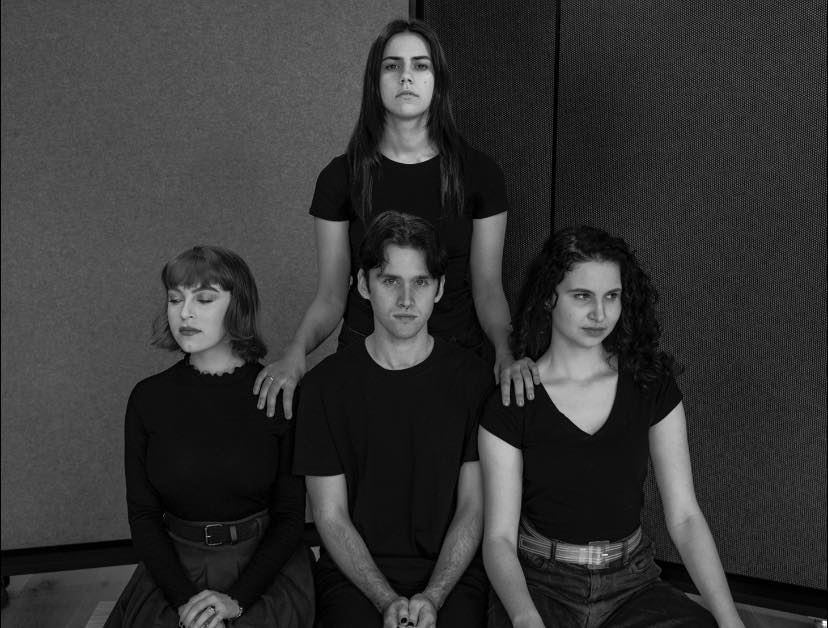
For clarity, it is important to note that the main difference in this production is the multiplying of Hamlet into three characters: The Prince (Bianca Sanchez Galvin), Hamlet (Narii Salmon), and Lady H (Bridie May Kelly). At first, I felt that this adaption goes beyond the means of its own plot. Where was Hamlet’s mother? Who kills Claudius? But then, I began to see this play less as an adaptation of Shakespeare’s text, and more as an adaption of the infamous play’s legacy. A multitude of snide self-referential remarks alerts us to this aim: Hamlet calls himself a “best-seller”, Ophelia’s ghost reminds us that she is just “a waste, a romantic sub-plot”. This production encouraged me to see Hamlet as a universe unto himself, where the plot is set, the threads are tied, but the characters continue moving through time and space to please new audiences.
The play opens with Hamlet (Narii Salmon) roaming the stage in darkness, avoiding the beaming spotlight that stands pregnant on stage left. The play truly begins when he assumes his place in the light, embracing his role and the fate that accompanies it. It is near impossible to escape the eternal spotlight on stage because as we all know, the audience in any tragedy is active and ever present. From our protected seats we are asked to question our role in propagating Shakespeare’s legacy of violence or otherwise.
Further, the actors’ genders, bodies, language, and delivery are all so subversive, challenging the ‘great man’ norm we have come to expect from Hamlet. I would encourage the actors to commit to this subversion by embodying their characters with their own voice and resist the temptation of mimicking what Shakespeare plays are supposed to be; European accents and deep bellowing (men’s) voices. Who’s to say you can’t deliver ‘to be or not to be’ in the treble clef?
The costumes were perfectly cohesive across the characters. The blend of modern street wear (we love a Hamlet in Doc Martens!) with more overtly theatrical costumes, such as Lady H’s gown or the Ghost’s fantastical garb, created a blend of realism and fantasy. The hand-drawn look of ghostly Ophelia’s gown alerts us that her existence is closer to that of a construction or caricature than a real woman. These aesthetics were combined with the spooky, anxiety ridden soundscape (Alexi O’Keefe) and set (O’Keefe and Rachel Stone) which created an almost Coraline-esque mindscape, fitting for a psychological drama with multiple realities.
The set served the dual purpose of establishing the gothic, haunted house aesthetic the play followed and cleverly supporting Charlton and Donato’s interpretation, literally enmeshing the characters in a web that grew more entangled as the play drew on. The meaning for the web is for us to decide; a reference to the three fates’ threaded weave, a determinism that Shakespeare might recognise, the ‘scripture’ of the play, the mythology and legacy of Shakespeare, the expectations of performance.
Considering the excellent acting in MUSC’s HAML3T, Horatio’s (Josh Higgins) easy stage presence was a highlight for me. His determined cheerfulness in the face of building chaos was charming and naturalistic. Horatio and Hamlet’s scenes also deserve recognition for their impressive and tender chemistry, where the audience collectively held their breath each time they stepped closer together. I was so relieved when their feelings for each other were confirmed. This would have been criminal queerbaiting had it gone unacknowledged!
The writing walks a line between mimicking the tone of Shakespearian English and embracing modern vernacular and wit. This is especially embodied in the sass disparaging remarks and exasperation wonderfully delivered by Kelly as Lady H. At times I felt the writers had conflated keeping the ‘good bits’ of the original text with the famous bits. This aided my interpretation of the play as a comment on Hamlet’s legacy, but at times I did miss the language of Shakespeare; the lyrical lull of iambic pentameter, and the meanings inherent in the text, not only those that had been created externally. I did especially enjoy moments when the original text played into Charlton and Donato’s interpretation: when the ghost bellows “I am thy father’s spirit” to the three Hamlets, he could equally mean “I am thy fathers” (plural) spirit. The three Hamlets represent three varying levels of Brechtian awareness and three different aspects of Hamlet’s personality: existential; anxious in-action; rash and witty. When the characters berate each other and fight, we realise that these fractured characters exist in conflict.
The three Hamlets’ performances were fascinating in their discrepancies. I loved the monologues delivered in unison, Hamlet with a self-conscious play-acting silliness—as if he’s done this before. Lady H and the Prince were presented with sincerity and resolve, as this is their first time experiencing the tragedy. The Prince delivered his monologues traditionally, addressing the audience without seeing us, whilst Hamlet completely dissolved the fourth wall making us complicit. “Revenge now, yes?” he teased us. Performance choices like these effectively alert the audience as to the characters’ varying levels of awareness that they are in a play.
My favourite aspect of this adaptation was the rehabilitation of Ophelia’s narrative and character. This is where the play engages most overtly with scholarship—directly addressing the feminist critique of Ophelia’s character as powerless. We get a clear dichotomy between the canonical Ophelia who is resigned to her fate—“I don’t take action”, she wailed—and the embodied and angered Fi, who exclaimed “I like it here”, unwilling to die quietly off-stage as merely a function for the plot. Giving Fi (short for Ophelia) her own ghost, as well as her knowing that Claudius is the murderer, gives her both interiority and character motivation which are lacking in the original text. This is epitomized in the brilliantly swapped “get thee to a nunnery” chiding which Ophelia delivers to Lady H.
At times, the play came across as a play for fans and scholars. An understanding of scholarly critique of the play and of theatre in general added my understanding of some of the creative choices made. For example, the meaning created in giving Hamlet’s “get thee to a nunnery” line to Ophelia, giving Ophelia choice rather than orders, relies on the assumption that the audience had knowledge of the original play in order to contrast.
This play has expanded far beyond its original universe of one man and his suffering. I wholeheartedly applaud Charlton, Donato and the entire cast and crew of HAML3T for stretching Shakespeare’s original into many dimensions, even if some things were lost or warped to new meanings in the process.
MUSC’s HAML3T ran May 12th to 14 at The Guild Theatre to three of four sold out performances.
 The Dialog