
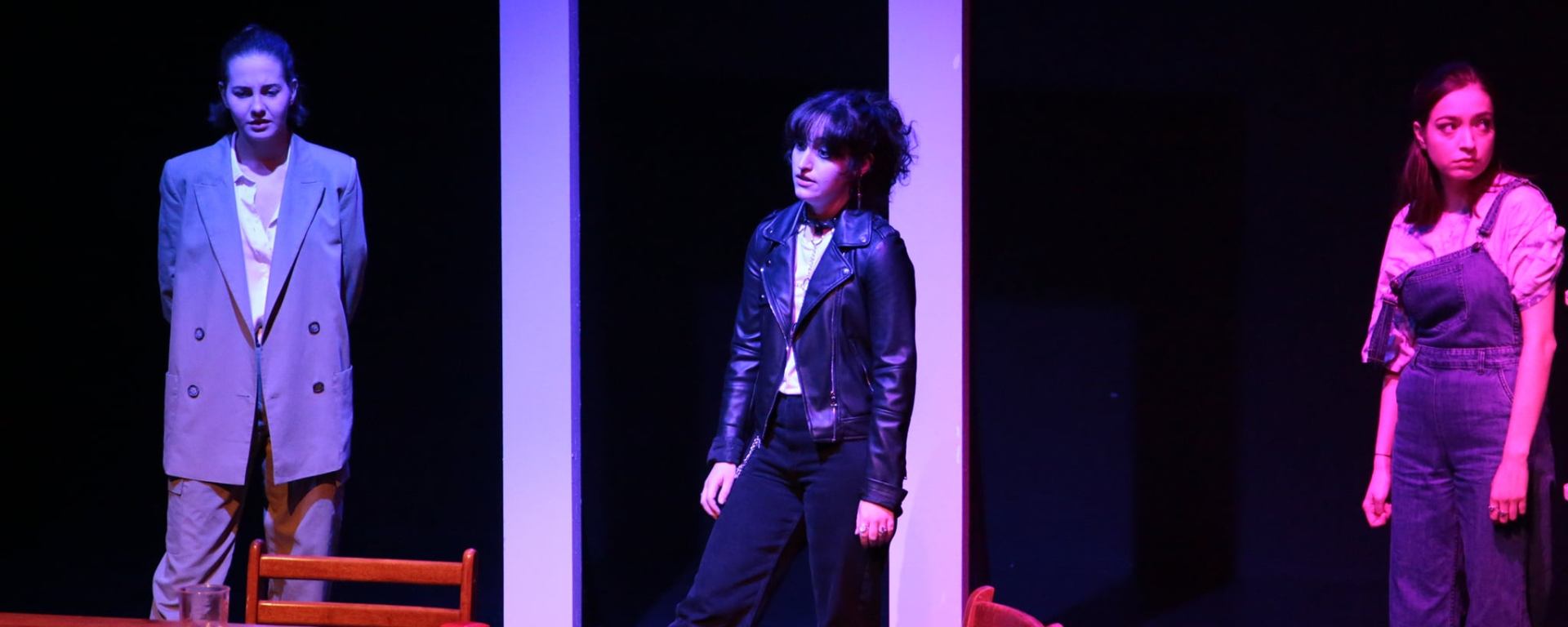
By Sophia Zikic
Two Nights Out of Bed, written by Will Farnsworth, strives for nuance in its depiction of queer life. Performed by the Four Letter Word Theatre Company, the play follows a Melbourne polycule, made up of three queer men: Andre (played by Katherine O’Hagan), a young man teetering on the brink of alchoholism; Damien (Sabina Donato), his much younger partner and recovering addict; and Julian (Liz Dokukina), an academic finally finished with his PhD and returning home. They are joined by their friend Viv (Angela Nguyen), who has just been dumped by their partner, and the play unfolds. The show explores how the characters navigate the complexity of their relationship during the aftermath of the 2017 Same-Sex Marriage Plebiscite and the trauma that intertwined with the politics of that time.
Two Nights Out of Bed’s set design rides the line between black box and realism. The Ikea couch and the takeout containers on the floor all paint a vivid picture of the kind of home these characters occupy—or at the very least, the space that they occupy while Julian is away. The black walls—always visible—and the large empty spaces on stage enabled the theatrical techniques that contrasted against the more realistic dialogue and acting styles. For example, Damian’s pacing during Andre’s panic attack clearly and concisely communicated the disassociation he was experiencing. There were specific touches that I enjoyed in the set, such as the use of posters and prints from the current (2022) Queer exhibition at the NGV. This choice (though breaking with the 2017 setting) gave an authenticity to the characters—as if they really do live in Melbourne, and they have attended exhibitions and bought prints from the NGV. I also appreciated the soundtrack choices, featuring songs by Tom Rosenthal. They were minimalist, but Rosenthal’s gently melancholic style complimented the tenderness of the scenes in which they were played. The other choices of sound design—such as a heartbeat for moments of tension—were neutral and less creatively inspired, but appropriately supported the narrative. However, in a show with distinct scenes taking place in memory, dreams and reality, it was difficult to follow what was happening. When the lighting changed to purple or blue to indicate that this scene was taking place in a dream or in memory, other details in the scene told the audience that this was the characters’ real world. This did not read to the audience as a deliberate directorial decision, and the timeline was further complicated by the constant presence of the ring box on the table, a motif that is specifically connected to the year 2017.
Farnsworth’s writing style seems to lean more to melodrama, as opposed to realism, which drew me out of the play at times. Particularly when contrasted against the dark themes of the script—alcoholism, addiction, homophobia (both externalized and internalized) and religious trauma—a character declaring that the Australian public “hate us” seems to be an oversimplification of a myriad of feelings that could have been expressed with more nuance. The line in itself is fine, but much of the script was written in this simplistic style, and it lessened the impact of the show’s sincerity. To be honest, the first half of the show confused me—it seemed as if there was something missing. Andre, Damian and Viv seemed amorphous to me; I didn’t really understand them, despite their exposition and raw expressions of their inner turmoil. Andre and Damian had a strained, conflicting energy, which undermined the authenticity of their relationship.
Then, in the second act, Julian enters the scene.
Despite the exaggerated dialogue, the presence of Julian transformed the story. I realised that the missing piece was a deliberate choice, and the distance between Andre and Damian was deliberately cultivated. In the narrative, Julian is revealed to be the most stable member of the polycule; he is successful, older and intelligent. He is unflappable, at stark odds with the fragility of the other characters. His presence revealed the complexity of the relationship and characters themselves—that Damian was much younger than his partners and is outsider in his own relationship with people that neglect his emotional needs. That Andre’s frustrating self-centredness drew from a deep insecurity, only temporarily stoppered by Julian’s stability, leading to Andre’s adulation of him. Julian himself was revealed to be a character of complexity, rather than the perfect partner that Andre and Damian imagined him to be. The performances of the actors were also elevated in the final act, with Dokukina particularly selling the coldness and moral complexity of Julian. In contrast, Viv was a fun character—Nguyen portrayed them with equal parts pathos and humour—but they seemed disconnected from the character drama at the heart of the play. Their personal plotline was seemingly irrelevant to the central narrative, and their reconciliation with an offscreen ex meant very little, despite the genuine emotional distress that the audience witnessed.
The politics that Farnsworth tried to engage with in the play are at once incredibly public and highly personal. However, the commentary and perspectives professed by the characters and the text were somewhat non-specific, and revealed nothing about either the characters or the political climate of the time, other than the postal vote was, broadly speaking, harmful to the Australian LGBTQIA+ community. Though I am in no position to comment of the authenticity of the other themes (such as internalised homophobia resulting from a religious upbringing), the monologues that elucidated these themes never seemed to quite connect the themes of marriage and Catholic guilt, though there is much to be discussed about the intersection of these ideas. The same thing applied to the alcoholism that each of the characters (save, perhaps, Julian) struggle with. This theme is never directly confronted by the text, only hangs implicitly in over the cast. This would be fine—it could simply be providing additional characterisation that does not need to be explicitly addressed—but alcoholism is indirectly referred to so many times by the characters as something that they suffer from specifically, that it was surprising when the play ended with no further or meaningful engagement with this theme. With that criticism aside, the most powerful moment of the text is when Viv monologues on the plebiscite. They state, with frustration, that the legalisation of same-sex marriage is only a reprieve and not a victory. When listening to this monologue, performed by the only non-binary character of the cast (and incidentally, played by the only person of colour), standing alone on stage, it was impossible not to think of the current climate of transphobia (issues compounded by factors such as race) that has persisted well after the debate of Australian marriage equality has ended.
Four Letter Word theatre engaged with a difficult and complex text and created a high-quality work of performance. The sincerity at the heart of the play was reflected in the actors’ performances and production design itself. There was something deeply interesting about Four Letter Word Theatre’s Two Nights Out of Bed, and in spite of its flaws, I found myself deeply compelled.
Four Letter Word Company’s Two Nights Out of Bed ran May 4th to 7th 2022 at the Guild Theatre.
 The Dialog