
By Olivia Borgstroem
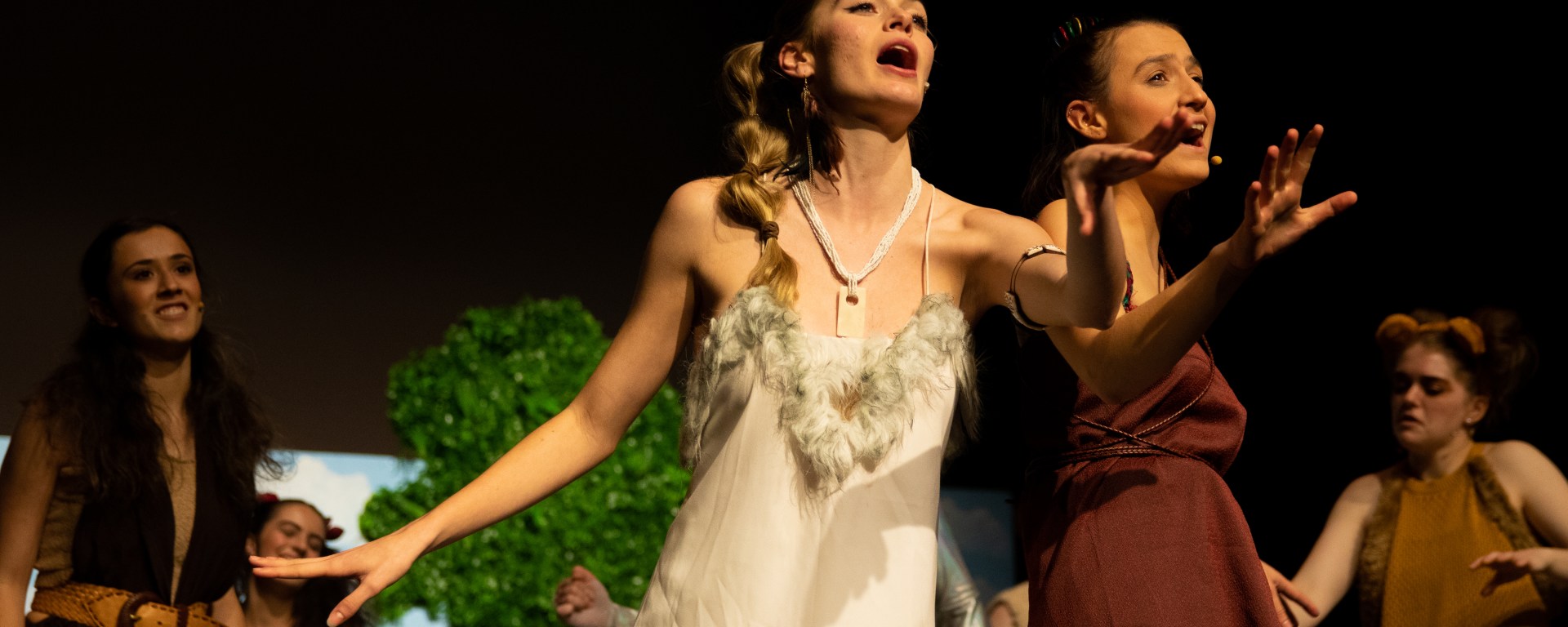
Firebringer was originally a book written by Brian Holden, Matt Lang, Nick Lang and Meredith Stepien, and premiered in 2016 as a musical produced by StarKid Productions. However, it went viral not for its adventurous storyline or witty jokes, but rather for the song ‘We Got Work to Do’ and the lyrics “I don’t really wanna do the work today”. I had previously only heard the song in TikTok videos—most of them about procrastination—and did not make the connection until watching the Intercollegiate Activities Council (ICAC)’s spectacular performance of the piece. Directed by Alanah Hardy, with musical director Ashley Harper and production manager Sage Agius-Giddings, Firebringer was a hilarious cartoon-like interpretation of the Stone Age, showcasing a cast with magnetic stage presence and a talented band.
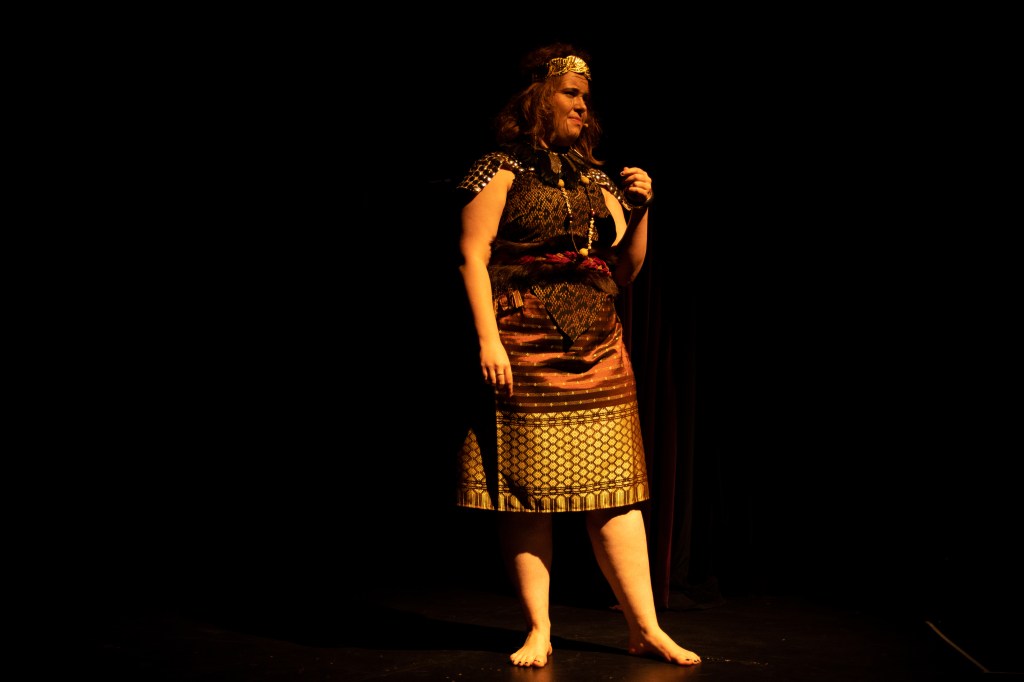
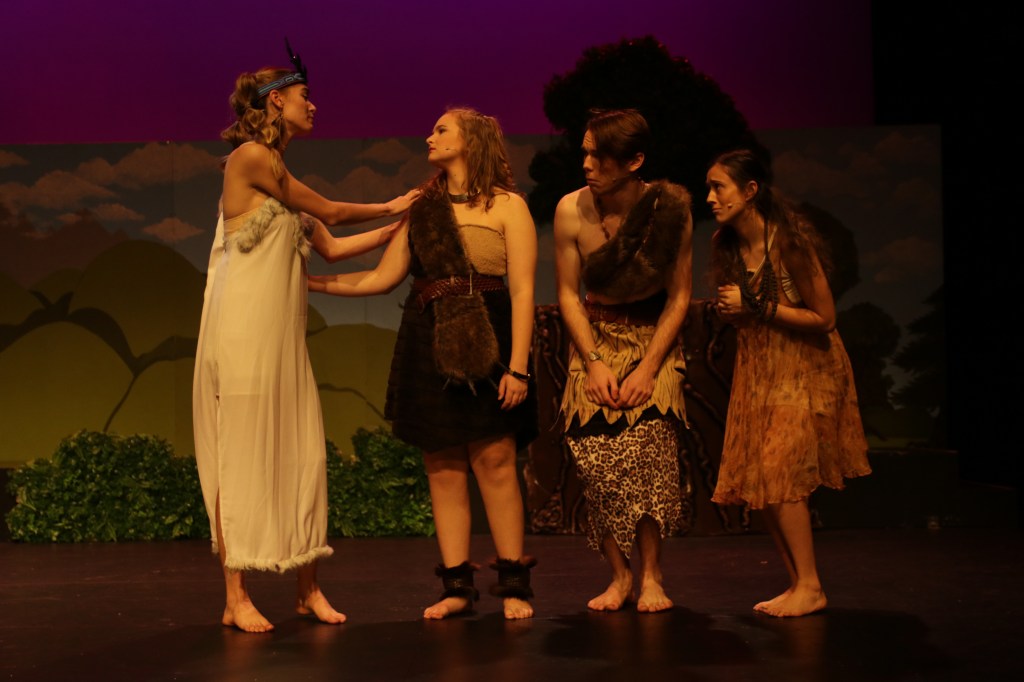
As a two-act musical comedy, Firebringer is centred around a prehistoric tribe who live on a foraging diet of nuts and berries, all while worshipping the Duck. Tribe elder Molag (Celeste Parkinson) acts as the play’s narrator and wisely details a peaceful life. Zazzilil (Grace Donnelly), tired of gathering food every day and sleeping in a wet cave, believes there is a way to do less work, but clashes with the tribe leader Jemilla (Eliza Griffin), who wants to maintain their current way of life. Zazzilil leaves abruptly in the middle of the night, and through a frantic series of events, accidentally creates fire with the help of lightning. Consequentially, the tribe banishes Jemilla and adopts Zazzilil as their new leader—the titular Firebringer.
With a predominantly female cast and Zazzilil as a strong innovative lead, Firebringer has an overarching feminist theme. This felt momentous, considering the majority of historically significant individuals and inventors credited in modern times are male. Although clearly fictional, the show provides a space for women and their part in creating history, without making a fuss about actually doing so. Women’s rights are simply taken for granted. It also seamlessly includes the display of male emotions, rather than playing into toxic masculinity, as well as the addition of queer representation. The all-white cast did, however, fall short in terms of diversity. Otherwise, an excellent accessibility feature of the show were the two screens displaying subtitles of the dialogue and songs.
What made this performance a delight to watch was the extremely well-embodied characters. The whole cast did an excellent job bringing out the different quirks of their characters through distinctive body movements and intonation in dialogue. The comedic Schwoopsie (Lexi Janesch), the crazy cultish Ducker (Elle Litras) and shy, sweet Tiblyn (Zara Sadhai, understudy to Claire Steel) employed impressively consistent vocal alterations that were on point, embodying their characters in a way that felt authentic to the musical’s essence. In another great example of superb acting, Jessie Williams’ big lazy doe eyes and head tilts portrayed Keerie’s innocently slow thinking with finesse. With such a wide embodiment of unique characters, no one was lost as an unknown ensemble member.
Additionally, interactions between the cast were filled with passion, with the relationship between food taster Emberly (Meagan Hansen) and outsider Grunt (Saul Kevanagh) being the most noteworthy example. Hansen and Kevanagh’s heartfelt performance of ‘Just A Taste’ was highly reminiscent of Hans and Princess Anna in Frozen’s ‘Love is an Open Door’. Their chemistry was electric, as Hansen and Kevanagh elegantly balanced the romance with nervousness and hilarity.
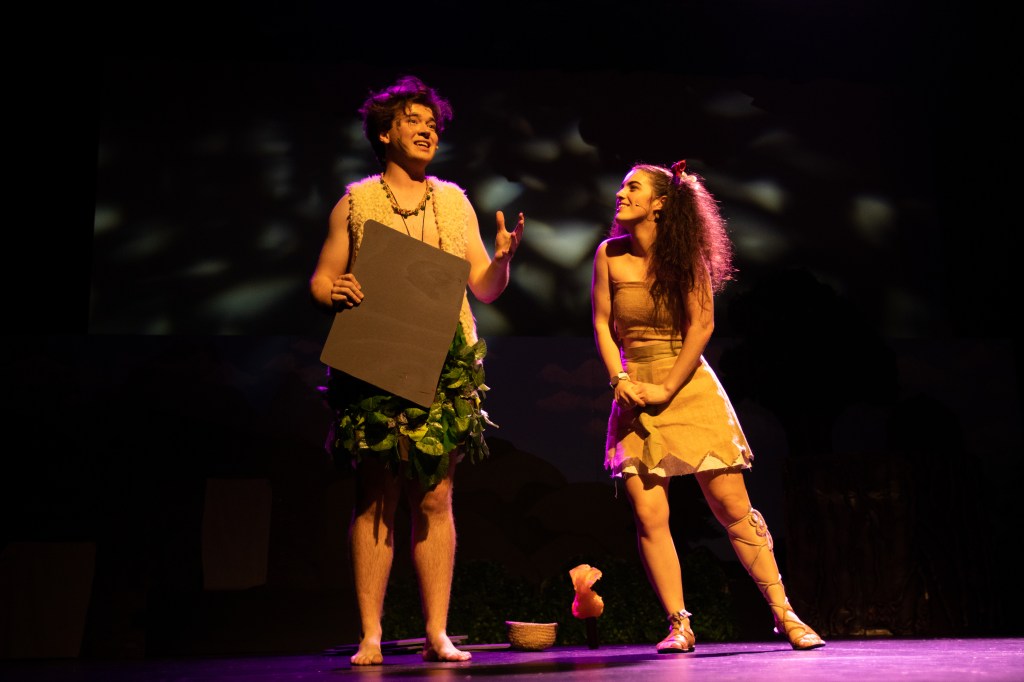
The cast’s performance was further enhanced through costume (Claudia Song), and hair and make-up (Alessandra Manyk), which were consistent with the Flintstones-like look of the original production. All the characters wore different styles with a common theme of brown fabrics and animal skins which created a cartoonish Stone Age interpretation. The stand-out difference was for Jemilla, who in the original production wore a simple two-piece in line with the other tribe members. ICAC’s Jemilla, however, wore a long white dress with fur trimmings in the neckline. This was a great creative decision, effectively making her appear royal and visually elevating her to the status of tribe leader. The tribe-member-turned-alien Chorn (Georgina Macho) donned an eye-catching silver jumpsuit for their dramatic reveal at the end of the show. The outfit’s shiny modern appearance fit the cartoonish theme to a tee, acting as the pinnacle of a stereotypically futuristic alien.
The set (designed by Corwin Getty, with construction manager Moya Lucy) depicted a lush green forest, featuring an elevated platform running the full width of the stage. This gave the otherwise flat set a sense of depth, creating separate spaces to differentiate between locations, whilst visually realising the tribe hierarchy during monologues. During more intimate scenes, the actors sat along the edge of the stage, inviting the audience to lean in and become a part of the scene. With the lighting designed by Lachlan Creedy, spotlights were cleverly used to create focus, producing an authentic dark ambiance suitable to the prehistoric period. The darkness additionally made the fake lit torches look magical, casting a red warm glow. Overall, the stage design and props were simple and employed a vibrant colour scheme, maintaining cohesion with the costuming.
The songs were performed remarkably well, with harmonies and polyphonic segments executed flawlessly—especially in ‘Into the Night’. Griffin delivered a stand-out performance through her confident and expansive vocals. Some cast members did at times go noticeably outside their vocal range, making their voices sound strained and significantly weaker compared to other songs. Impressively, in a soundscape designed by Finley Edmonds, instrumental music was cleverly used behind dialogue to amplify the atmosphere. The same pieces were repeated in multiple scenes, allowing for a comforting anticipation when hearing the familiar tune. Moreover, the band played so flawlessly that I did not realise they were live until after the show—a truly outstanding performance that is worthy of commendation.
Overall, ICAC’s Firebringer did an outstanding job portraying the feminist, religious and climate-related political themes of the show, creating a rib-tickling fictional history lesson with nuanced characters that connected splendidly with the audience. The cast had a fabulous vocal range, bolstered by dark dramatic lighting and prehistoric parody costuming, rounding out the authentic Stone Age comedy with ease. Truly, it was a delight.
ICAC’s production of Firebringer ran May 12th to 14th at the Union House Theatre.
 The Dialog