

By Sophia Zikic
If I needed to summarise the University of Melbourne Music Theatre Association (UMMTA)’s production of Footloose in a few words it would be this: it is exactly what you want from a production of Footloose.
For those unfamiliar with the original 1984 film starring Kevin Bacon, the much-worse 2011 remake or the musical adaptation itself, the bare-bones plot is as follows: Ren McCormack, a teen rebel, and his mother Ethel move to the town of Bomont, situated somewhere in the American South. Ren learns that the local minister Reverend Shaw Moore has banned dancing (along with drugs and alcohol) within the town boundary after the death of his son in a drunk-driving incident. McCormack leads a student rebellion with the help of the Reverend’s daughter Ariel, and—here the musical differs from the film—eventually manages to convince Shaw to see the error of his ways. There is a weird throughline of domestic violence that is never directly engaged with in the production, with some perpetrators being treated as irredeemable, while others are allowed to be redeemed by their personal arcs. But other than that note, the plot is relatively straightforward.
Yet writing out the plot does nothing to convey the intensity of this fabulous performance by UMMTA, directed by Teresa Giansiracusa, assisted by Tom O’Sullivan (assistant director), Louis Ajani (musical director) and Julian Smith-Gard (assistant musical director).
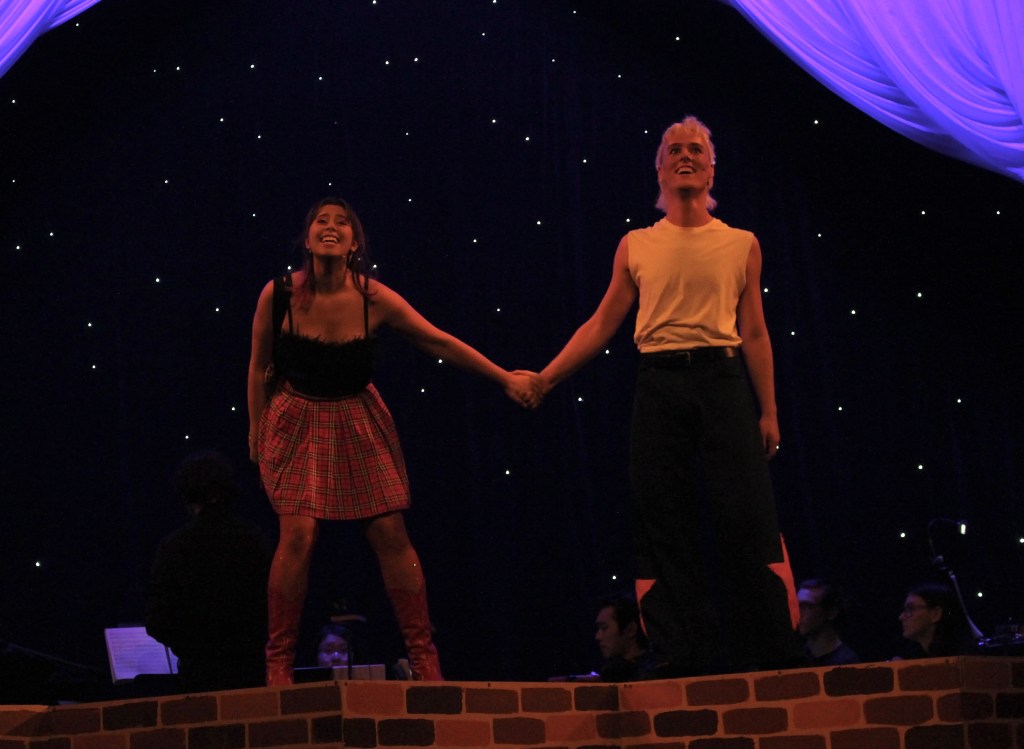
The design of the production was overwhelmingly effective. Natalya Shield (lighting designer) and Taishah Simcox (assistant lighting designer) did an exceptional job, with a fine eye for detail. During the single church scene in the production, the silhouette of a stained glass window was cast onto the stage in orange, a detail that would have been easily missed but contributed strongly to the texture of the scene. Of particular note was the wall of LED stars, hidden behind the curtains at the back of the stage. This element of the set, designed by Bridie Turner and Sam Osburn Rassaby, was a standout feature of the show and was used to great effect in scenes that required a more subtle tone. The costumes were highly impressive, communicating character as soon as each performer appeared on stage. Ren’s (Flynn Smeaton) white singlet and navy-blue flares with giant orange stars on the legs and Cowboy Bob’s (Isabella Chavez-Romero) bedazzled cowboy hat and white suit spring to mind as great examples. Similarly, Rusty (Ninna Aguirre), Urleen (Darcy Towe) and Wendy Jo’s (Jo Jabalde) plaid skirts—each a different colour and coordinated with the rest of their outfits—were a few more shining examples among the 80’s technicolour extravaganza produced by the costume department, headed by Karen Spencer and Joshua Bartsch.

The cast, too, was very impressive. Smeaton, rocking a platinum blonde mullet (ironically back in fashion, after 40-odd years since the original film was released), performed with gusto, high kicking and leaping across the stage with what seemed like boundless energy, though the choreography—while very impressive—tended to be repetitive at times. The entire cast was strong and worthy of praise—but what distinguished the most impressive actors were how some disappeared into their roles. Emma Gare, who played Mrs Moore; Will Palmer, who played Ren’s friend Willard; and Ninna Aguirre, who played Rusty, brought their characters to life with a flourish, and were able to impressively maintain their Southern accents. Ren and Ariel (Rachel Dwyer)—through no fault of their actors, who gave fantastic performances—suffered somewhat from main-character-blandness, when the main characters must be relatable to the audience, and therefore, devoid of any character traits that make them truly unique. This was doubly apparent when comparing Ren and Ariel to the secondary couple, Willard and Rusty, who were delightfully eccentric characters, played by actors with great comedic chops, and therefore had a far more interesting relationship. Similarly, Reverend Moore lacked pathos—though his songs were wonderfully sung and performed by Joshua Sumner—purely because the character did not possess much personality.
In regard to other directorial decisions, changing Chuck (Ariel’s bullying boyfriend, played by Marchella Rusciano-Barrow) from a male jock to a female cheerleader, backed up by a clique of Mean Girls style bullies, was fun, and generated queer representation in a text that previously lacked it. Chuck was also a great deal more interesting than the “pure” representation that audiences have grown familiar with. Sometimes, lesbians are bullies! Diversity win! But, inadvertently, this emphasised the heteronormativity in the rest of the musical. At the end of the musical, when all the couples emerge on stage to wrap up their plot threads, they are all obviously straight.

Footloose was supported by an eight person live band, and flawlessly matched the quality of the stage performers. To the casual listener, there was no note out of place. I particularly enjoyed the performances of Kevin Woodhouse on the flute and Sophie Barker on the marimba. Unfortunately, some of the sound mixing was inconsistent, and occasionally the performers were inaudible over the orchestra. Lyrics were displayed for accessibility on small screens on either side of the stage (and were supported by skilled sign-language interpreters who translated the entire production), but the text was too small to follow comfortably from the back of the theatre, which was a major oversight. It also seemed as if some the singers were forced to sing above or below their natural range, sometimes resulting in a strained quality to their voices, occasionally even becoming flat. However, this was only noticeable in certain moments, and did not detract from the overall production. The majority of the songs were good, but the best were certainly ‘Footloose’ and ‘Holding Out For a Hero’, which were great high-energy numbers performed with gusto by the full cast. ‘Learning To Be Silent’ was another standout, performed by Rachel Dwyer, Emma Gare and Lana Davey, whose voices melted together with skill reminiscent of a vintage, all-female acapella group.
UMMTA’s production of Footloose was truly an achievement. Writing this review and referring to the long list of primary cast, ensemble, production team and band members revealed how much of a collaborative effort this production was. The individual effort put into each element of the project—be it costume, choreography, set or lighting—was obvious in the final polish of the production. Even for those not particularly keen on musicals, there was something for everyone in this production of Footloose, and I look forward to seeing UMMTA’s next show.
UMMTA’s Footloose ran May 4th to 7th 2022 at the Union House Theatre.
 The Dialog
“At the end of the musical, when all the couples emerge on stage to wrap up their plot threads, they are all obviously straight”
While I appreciate your review of a musical I also enjoyed, this sentence in your review is inexcusably homophobic. The diversity of individual experiences in both their gender identities and sexualities cannot be known by audience members, and to make a cis-gendered heteronormative stereotype in your review is an insult to the queer members of this production, and the characters they portray.
Hi Megan! Sorry for the misunderstanding. The statement was specifically about the heteronormativity of the text. I was not making any assumptions about the cast. Chuck’s gender swap introduces a queer relationship to an otherwise entirely heterosexual text and results in the character of Ariel being coded as bi. These changes are all positive efforts towards broader representation. However, at the end of the show, each remaining relationship (although not necessarily all characters) is straight (between characters coded as men and those coded as women). This undercuts what are otherwise positive efforts towards improving queer representation by having the musical return to the heteronormativity inherent to the original text. To be clear, I am not making this criticism based on any of the cast members, but instead the gender coding of the characters themselves.
I agree with Megan on this one. Having seen the production myself, I noticed that all the ensemble were paired or ‘coupled up’ as queer relationships – both in character and in actor body. I appreciate and understand your perspective however, your review still shows underlying homophobia.