

By Sophie Barker
Sat in a darkening theatre, the white, empty room on stage teased veiled shapes to an eager audience. The sudden brilliance of harsh light, reflected off of the nothingness of the set, was almost blinding. Following a particularly long, tense silence, Clov (Sasha Čuha) enters, the mood is set, and Endgame—directed by Arthur Knight and produced by MU Modern—begins. Almost two hours later, when the lights finally cooled, I was left with no greater understanding or clearly conveyed message, but simply a jumble of impressions that rolled around my head, ordering and reordering themselves into something that occasionally resembled coherence.
Having had limited interaction with Beckett’s plays, and certainly never having seen one live in performance, I had no expectations upon entering the theatre. The seemingly complete nonsense I was presented with was, then, understandably, difficult to follow; frustratingly so at times. However, the cast’s tight, exacting movements and intonation as each repetition of dialogue or movement sequences occurred provided something solid to hold onto in the chaos. Their command of the stage and inhabitation of the characters was convincing and authentic that it drew me in despite the feeling of floundering. Many of the difficulties I found in viewing this production stemmed from its text and were alleviated by the performance, without completely erasing the incongruity inherent to Beckett’s writing. Nonetheless, it was a long production, running 40 minutes over the expected length, and made all the more extensive by its frequent, pregnant pauses.
As much as I was overwhelmed by the sheer amount of dialogue, I was equally encompassed in quiet. A stealthy sound design by William Mason preyed on these moments and toyed with long tones and drones of differing frequencies, which were varyingly soothing and irritating. What seemed to be the sound of fans and a general electronic whir also underscored the performance, though—to me—it was not clear whether it was an intentional sound or not. Nevertheless, it gave a certain weight to each pause, simultaneously stretching the silence and functioning as a distraction, compressing our time in the theatre. Before long, it was unclear where time stood in relation to my normal reality.
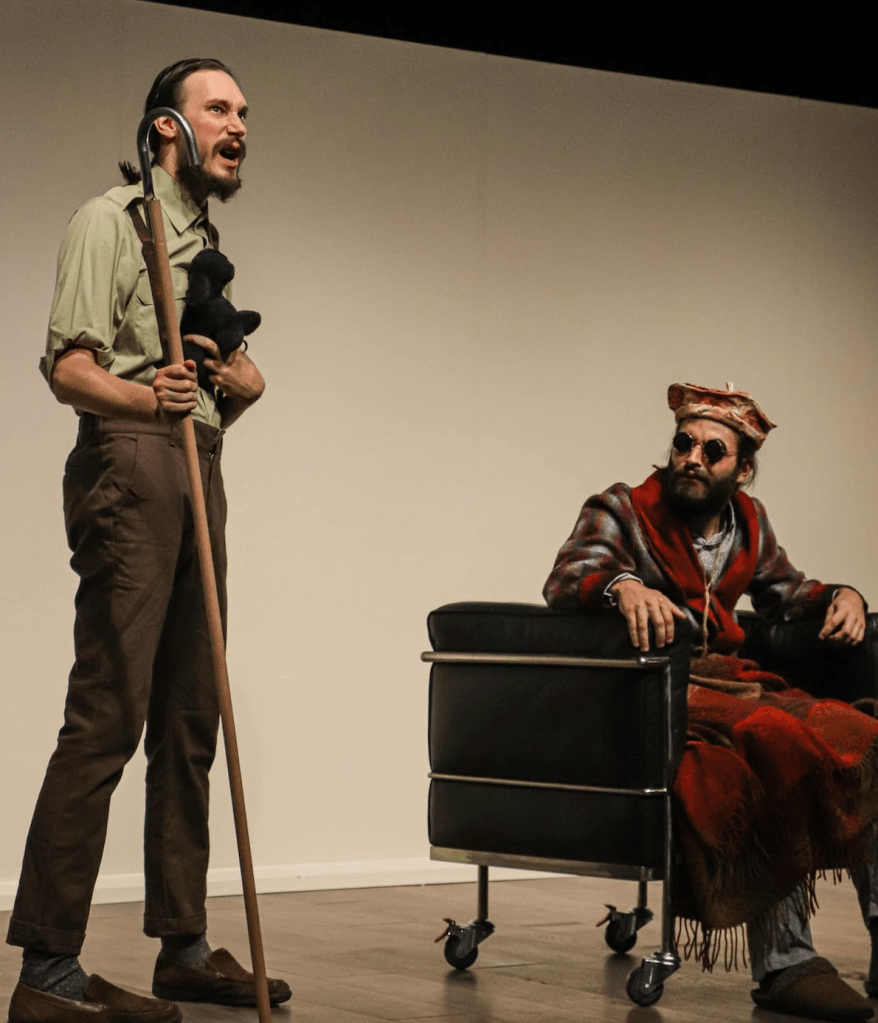
Costuming also contributed to the establishment of a play world which operates according to different rules than ours. Abbey Stanway’s costume design was coherent between the characters but grated against current trends, situating the performance in a distant time period which blended elements of past and future. The use of blocked neutral colours resonated within the drab setting, whilst Hamm’s red coat and blanket pulled focus, cementing his central role.
The lighting design by Jacob Trethowan relied on subtlety, slowly shifting from the full stage being awash in a harsh white light to a warmer, yellower tone with shadows creeping along the edges of the stage. Given this lighting change was never sharply asserted, it was long into the play before I realised that I was leaning in, peering at a stage which looked not quite like it once did, though I couldn’t put my finger on the change at the time. Even after realising what it must be, even now, I cannot say with certainty that the lighting had been brighter at the start. It may simply have been a trick of the mind—or, more likely, evidence of the show’s genius. The lack of stimulation from by the white box set (designed by Jack Murray and evocative of Peter Brook’s work) was a bold choice, but its ability to challenge my faith in my senses and upset my perceptions of reality mirrors Beckett’s absurdist writing and wholly serves the text.
The talent of the cast and their unity in the face of a complex text was a crowning achievement. A pleasing balance physically and vocally was established when the four actors were onstage. Those who were confined to a garbage can or chair particularly commanded their space and were able to draw attention to themselves without becoming overbearing. The introduction of Hamm (Eden Gonfond) as a veiled figure waiting onstage as the audience entered the theatre established this dominance perfectly. First the sheet was pulled back to reveal his slippered feet with legs tucked under a blanket. Amongst all of this fabric, we were not, initially, certain whether there really was a human underneath. The sheet was then lifted to reveal decidedly human hands. After this extended tease, the sheet was pulled off of Gonfond’s face, only to reveal a smaller handkerchief that still covered his features. Eventually I gazed upon Hamm, his face still partially concealed behind dark glasses. The hidden humanity was finally revealed—only to be perplexed by his convoluted speech. In a similar vein, the dramatic makeup of Nell (Karla Murphy) and Nagg (Freddie Carew-Reid) emphasised human flaws to the point of seeming inhuman, highlighting their wrinkles, lines and shadows of the face. Their drastic paleness also suggested a melting away of their characters into the whitened world of that blank white room, as much a part of the furniture as a living, breathing creature.

The struggles of minimalist stagecraft, however, is that there is nothing to hide behind. Whilst the majority of the performance was compelling, various moments of hesitation in placing props or breaking a characteristic vocal inflection or physical tick were particularly noticeable, drawing away from a total investment in the play’s world. Some moments—such as figures repeatedly walking past offstage lights and casting shadows onstage or a prop thrown and landing in the audience—didn’t feel consistent enough to be intentional, though neither did they garner a visibly startled response from onstage. It is hard to identify whether they were merely a few errors played off surprisingly well or directorial choices which failed to convey meaning to me, leaving these moments as a strange sort of in-between of our reality and that of the play.
The nonsense of the play was conveyed particularly successfully through well-executed comedic timing and a convincing control of the text. Self-aware production terms sprinkled into the dialogue was initially jarring, swiftly giving way to humour as beats for tension and release were deftly navigated, which generated generous laughter.

The final moments, however, felt underwhelming. After the foreshadowed departure of Clov was aligned with the ringing of the alarm, I expected the clock—so pointedly moved on stage and hung in prime view—to play a role. Particularly with Clov remaining onstage for Hamm’s final monologue, it was hard to determine if his character had indeed left. Leaving the audience with a ringing alarm in the darkness of the final blackout could have confirmed that he had left. Aesthetically, it would have also satisfied a certain symmetry in the play, echoing Clov’s opening laughter with the announcement of the alarm as signifying his departure. Though perhaps this unfinishedness, this discomfort and dissatisfaction, was a more apt closing to an intentionally challenging play.
Overall, Endgame was a difficult show to watch and a bold choice to perform. The conviction of the performers and the success of the minimalist creative choices, however, brought it to life—in all its absurdity. Strategic set, lighting and sound designs accentuated the discomfort and confusion within the play, affirming its disconnection from reality—distancing the audience in such a way as is demanded by Beckett’s text. This production created an unsettling viewing experience and a performance which captured my thoughts long after its final moments. Endgame was a discombobulating experience, made all the more enjoyable by the talented cast and its innovative creatives.
Endgame was a Melbourne University Modern Theatre Company production that ran April 27th to 30th 2022. It was performed at the Guild Theatre.
 The Dialog