
By Celia Harvey
Photography by Ben Fon
Captivating, disturbing and piercingly relevant, Nora: A Doll’s House, directed by Xanthe Beesley and Liv Satchell, is Union House Theatre’s (UHT) triumphant send-off to the old Union Theatre. This long-anticipated show premiered on the 27th of April after a preview performance on the 26th. Nora is Stef Smith’s radical adaptation of Henrik Ibsen’s A Doll’s House, taking Nora and splitting her into three characters set in the years of 1918, 1968 and 2018. It loosely follows the original plot, adapting with depressing ease to each time period. It is evident that even though she is in ostensibly different circumstances to her original era—and women’s rights have advanced significantly—very little has changed internally for Nora. The home, marriage and family proves to be just as suffocating, making her reclamation of freedom just as radical.
The performance was highly polished, tightly weaving between the different timelines with ease, attesting to a high level of cohesion between the departments and the performers. The composition of the stage was immensely satisfying. The perfectly pared down set, designed by Claudia Mirabello, allowed us to see past the trimmings of each time period. This allowed for the performers to be staged in many creative ways, occupying the space and engaging with each other. Merging the convergent plot lines happened with ease, especially in tandem with a captivating use of choreography and movement.
As the audience entered, many of the Noras and Christines were scrubbing and sweeping, while the men walked about leisurely, establishing the production’s masterful use of space from the very beginning. That the stage was used in such an effective way felt like a fitting farewell to the space.

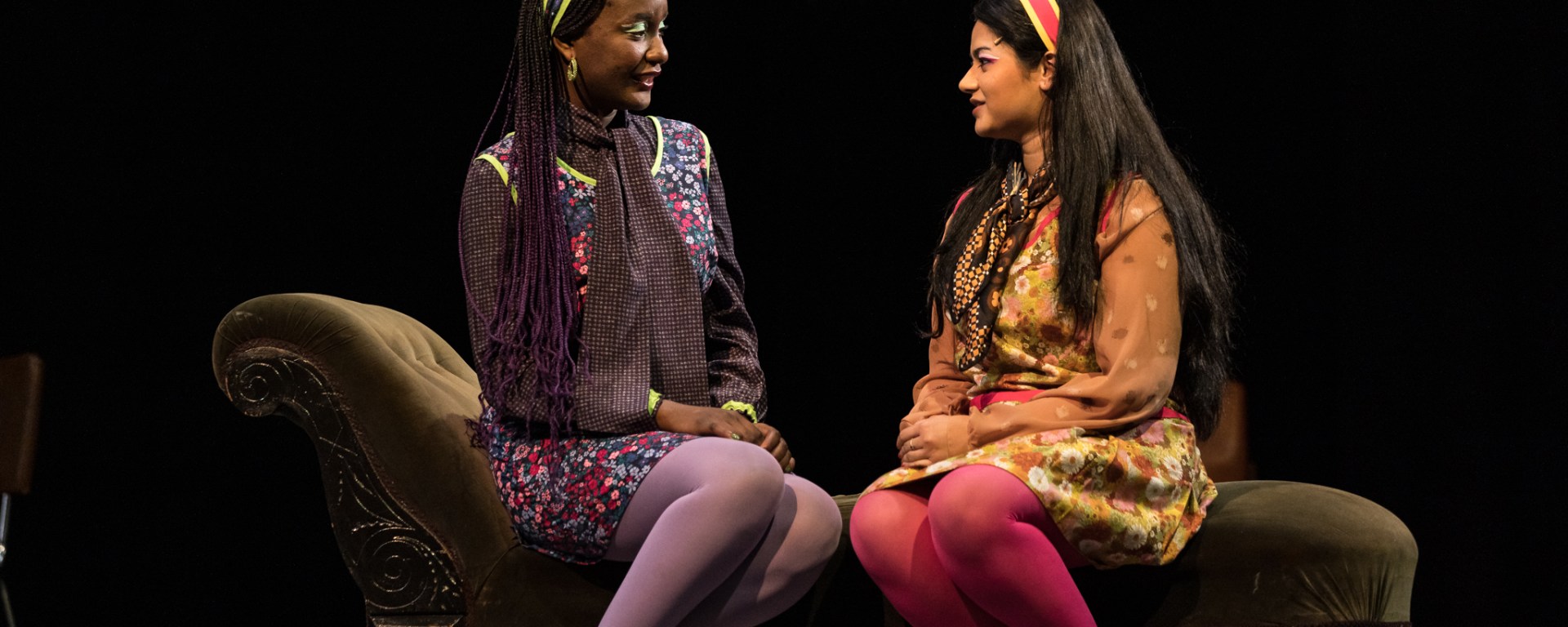
While Nora and Christine are split into three roles each, the men (and their expectations) remain static. Nora’s husband Thomas, the family friend Daniel and Nora’s blackmailer Nathan are played by one actor apiece. The costumes (designed by Natalie Gillis) were a highlight of the production, with the male characters dressed in modern clothes throughout, while the Noras were specifically dressed to their time periods in detailed, vibrant costumes. Having established the differences in their circumstances through costume, in the final, most touching part of the play, costume is used to highlight their solidarity: the Noras joined together through time. Their party dresses, styled differently according to their respective times, are made from the same green fabric and a similar style, creating a powerful image as the three finally face each other. Each Nora is no longer by herself in her decision to leave, and they are strengthened by each other’s resolve.
Leah Bourne portrayed 2018 Nora with incredible sincerity and openness. She embraced the visceral nature of Nora’s character, infusing her role with uninhibited physicality, focus and clarity as well as excellent chemistry with her fellow performers. That said, the 1968 section was the weakest in terms of the writing, with quite a few exposition heavy lines where characters reminded each other that it was 1968 and they could now access abortion and contraception. The costumes and makeup, although the most visually striking and vibrant of the production, also stood out for being less realistic and everyday than the other time periods, creating a somewhat inconsistent and surreal effect. Despite this, Abigail Kargbo and Anannya Musale (playing 1968 Nora and Christine respectively) portrayed their characters and relationship with such subtlety, introspection and chemistry that the clumsy dialogue’s effects were minimised. Similarly, Tulipa Rodriguez-Quin gave a touching portrayal of 1918 Nora. Being set the closest in time to the original play, her classically naturalistic performance felt appropriate. It was a fully realised portrayal of a solemn woman with sorrow and vulnerability hidden just beneath the surface. Her facial expressions were haunting, hinting at all the words left unsaid.

The use of lighting design by Giovanna Yate González was a high point in the performance, setting the tone and creating haunting images throughout. The particularly strong instances of this were the looming streetlamp literally spotlighting Nora’s loneliness and the isolation she felt inside her home, the dramatic red light bathing the stage during the tarantella dance scene and 2018 Nora’s final exit, when she was waiting outside alone after having left her husband.
Connor Ross’ soundscape is to be applauded as well. Music bubbled under the surface throughout, steadily building the tension and unease that was essential to the successful embodiment of the work. The production was filled with powerful movement and choreography, starting with the Nora in 2018 grooving to barely audible music—distracting herself from her troubles and Thomas’ hostility—and culminating in the wild frenzy of the tarantella dance involving every female ensemble member. By multiplying the dancers from just Nora (as in the original) to the entire female cast, Nora created a particularly striking image: women, adrift in time, coming together to dance through their anguish. James Madsen-Smith, who played Thomas, was tasked with driving the main tension of the plot. He did so exquisitely, seamlessly connecting and responding to each Nora, and using great timing and tone to avoid being a static one-note villain. He was so believable in his role that he often had the audience scoffing in fury but also laughing in moments of black humour.
While the play is set in the UK, this production, as evinced by the colourful prop money and the characters’ accents, is set in Australia. While this decision allowed for the best performances possible, it caused incongruity when discussing the timeline of women’s rights, which are deeply relevant to the play. For instance, it is a strong plot point that Nora gets to vote for the first time in 1918, whereas in Australia, white women have had the vote since 1908. Even so, it is an incredibly emotional section of the play to see Nora moving past Nathan’s taunting and experiencing the joy of having a civic voice.

This adaptation, at its heart, is about the fraught marriage between Thomas and the Noras and how these themes ripple across history. This tightness and intensity of meaning is compelling, but it also means that the side plots and characters tended to fall flat. The Christines, excluding the half-realised 1968 addition of a romantic subplot between Christine and Nora, felt interchangeable and one-dimensional.
As such, a low point of the production is its treatment of the ensemble, who aside from several brief but powerful moments, were superfluous to this intimate, domestic drama. One wished they were either utilised more or not included at all. The marketing for Nora: A Doll’s House, which used completely equal alphabetised billing (with no role listed besides the names) effectively promoted the show as an ensemble piece, which was not reflected in the final production. The work also suffered from some uneven acting performances, with performers who struggled with energy and enunciation cast alongside much stronger performers, resulting in moments of broken immersion. However, it should be acknowledged that at least one actor was replaced last minute. On the whole, though, the performances were strong, executed with great timing and effectiveness.
Despite these relatively minor shortcomings, the performance was an adept, thought-provoking piece of theatre that left one feeling both disturbed and uplifted, touched by the solidarity and power of the Noras across time. It was an ideal farewell to the Union Theatre, and it makes me all the more excited for UHT’s new era, where I hope to see that they continue showcasing compelling performances like Nora.
 The Dialog