
By Olivia Borgstroem
Although key to the rise and fall of Shakespeare’s Macbeth, the three witches known as the Weird Sisters were left in the shadows in the original play, with their most notable characteristics being their evil minds and supernatural activities. The Witches of Macbeth, a new work written and directed by Christina Wells, challenges this narrative through a comedic retelling of the events of Macbeth from the witches’ point of view. By the witches themselves discussing the storyline before the events of the play have taken place, The Witches of Macbeth is a work of metafiction. This redirection made the audience burst with laughter, regardless of any previous knowledge of Macbeth.
The show begins with a brief but tender moment between Lady Macbeth (Penelope Gordon) and one of the witches, setting the scene for the pair’s secret love story. It was exciting to see queer representation included, especially with some of the cast being a part of the LGBTQIA+ community. The three witches (Sophia Zikic, Brigid Charis and Christina Wells) delivered a captivating summary of Macbeth’s fate in a slam poetry style, a format which was both entertaining and informative. From these initial scenes, the plot unfolds with the prophecy of Macbeth (Clayton O’Toole) becoming the king of Scotland, the witches’ unsuccessful attempt to stop the murder of King Duncan and as a result, their later struggle to kill Macbeth.
Throughout the performance, sharp sarcasm and modern references were cleverly interwoven with traditional Shakespearean verse, creating a laughter-filled show. The script was supported by excellent emotional feeling and acting, with a special notice of O’Toole’s passionate monologue towards the end. Two original musical numbers were also featured, with the descriptive names of ‘Invisibility Potion Rap’ and ‘People Who Kill Bagpipers’. Both songs were hilariously executed, especially by Charis, with dramatic dance moves to accompany them. While simple and performed with the varying vocal skills of the witches, the songs were very in character and would not have been as believable or entertaining had the vocals been more refined.
Apart from these two musical pieces, the first witch suggested on multiple occasions that the sisters should take a song-and-dance break, yet the audience was left wanting and curious as no further break took place. The suggestion of these breaks nevertheless provided a moment of comedic relief after some scenes, whilst also creating a clear pattern to indicate that the storyline was moving on.
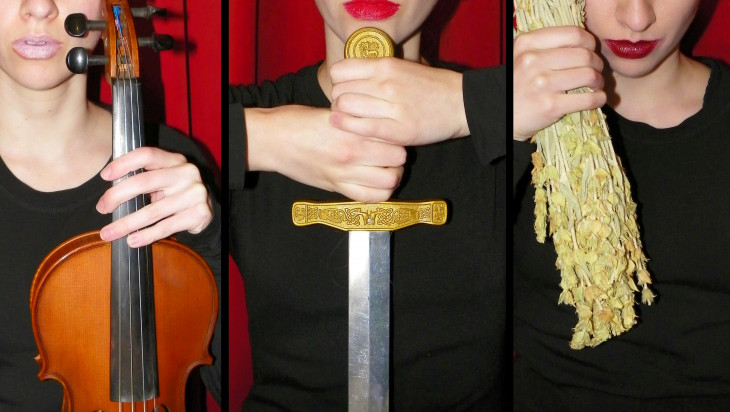
The use of a live violin and a brief guitar piece, impressively executed by Wells, were a great addition to the musical elements of the show. That being said, the Motley Bauhaus’s speaker system did not do the audio effects justice, and produced a distracting buzzing noise when not in use. Thankfully, the small space and the clear annunciation of the actors meant that no mics were needed, and as a result the buzzing speakers were only present for a minor part of the show. The limited size of the stage was circumvented with the use of the area in front of it, effectively creating a greater sense of space and depth. This was also a creative way to differentiate between locations in the plot. When using the space in front of the stage, however, the sparse lighting did not properly light up the actors and left some of their expressions obscured in darkness. This created a decidedly sombre mood. Whilst this may have been an intentional decision to recreate the original ambiance of Macbeth, it did not match the otherwise light-hearted tone of the show.
Few props were used, and to great effect, with creative solutions for somewhat difficult items to use in a small theatre, such as using a water jug instead of a cauldron. The three witches’ costumes were uniformly black yet clearly communicated their different personalities: for example, one witch wore a long skirt and belt, while another was clad in exercise tights. The costumes added a comedic effect, and the performance would likely not have been as enjoyable with a more elaborate wardrobe. Another prime example of this was when the witches dressed up as a demon to scare Macbeth. The “demon” had two long arms made from pool noodles and dishwashing gloves. The arms and ungainly walk of the demon was hilarious and far from terrifying, completely changing the otherwise dark scene in the original tragedy.
Towards the end of the show, the witches gather after Macbeth has died to ponder the events that had occurred. It is brought up how this retelling of Macbeth from their point of view is much like every other story, where there will always be side characters that we, the audience, will never truly know or understand. I could not agree more—as storylines are likely to contain biased views and a skewed representation of characters because of the protagonist. The Witches of Macbeth is a true example of a well-known play where just a slight shift in perspective brings a completely new story to life. The show allows the witches to redeem themselves and for the audience to better understand them. This form of retelling is rare in theatre and it would be intriguing to see more examples of it. However, it is important to maintain high quality stories worth telling, rather than exploiting beloved plays. This frequently occurs in the book, movie and television industries, and I would hate for the same to happen within theatre. The Witches of Macbeth embodies what a great retelling should be; thought-provoking and respectful of the original work, yet able to stand proudly on its own two feet.
Overall, The Witches of Macbeth was an original laughter-filled indie play with a lot of heart and personality, providing a glorious mix of ragtag costuming, a script bursting with opportunity, and passionate actors with plenty of stage presence.
The Witches of Macbeth ran April 19-24 at the Motley Bauhaus as part of the Melbourne International Comedy Festival.
 The Dialog