
By Sophia Zikic
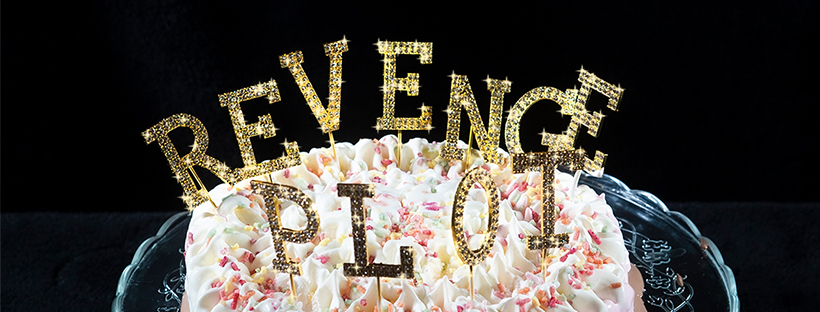
Dana Mitchell’s one-act romantic comedy Revenge Plot details the chaos that ensues when a group of vindictive 20-something-year-olds are slighted. Friends Lexi (Lani Mitchell), Anna (Ell Foreman) and Faye (Mia Haragonzó) attempt to throw a birthday party for the recently-dumped and slightly-pathetic Max (Lewis Mitchell), whose girlfriend has banned him from the joint party he had originally organised with her. The group resorts to subterfuge, sending spies to infiltrate the rival party and orchestrating elaborate social media posts to steal its guests.
As you’d expect, things get out of hand.
Mitchell orchestrates complex circumstances to create her comedy, and much of said comedy is centred around the interpersonal dynamics and resulting miscommunications and farce of her characters, all of whom seem deeply familiar. The hopeless romantic Max, the social-media-addicted Elliot (Vateresio Tuikaba), the homoerotic female besties Anna and Lexi, the vaguely-pagan Faye and your male-chauvinist friend Drew (James Ness) are all familiar archetypes, particularly to a young Melbournite audience. These characters feel like portraits of Mitchell’s community, and Revenge Plot speaks to Melbourne students in a way that is reminiscent of Josh Thomas’ Please Like Me or Chris Lilley’s Ja’mie: Private School Girl (in only the best of ways, as Revenge Plot lacks Lilley’s overt racism). The dynamics between Anna and Elliot, and Anna and Lexi were especially compelling and felt very natural, but perhaps due to the brevity of the play (Revenge Plot is only 60 minutes long), the other relationships did not always have time to breathe.
Many of the scenes, specifically those that involved only dialogue between two characters, were genuinely hilarious. Anna and her work-crush Elliot’s longest scene was exceptionally good, maintaining the careful balance of blossoming romance and second-hand embarrassment in a way that carefully stops short of being unbearably cringe, while maintaining levity and warmth. Lexi and Drew were also strong characters, and their power plays (think unstoppable force meets immovable object) were highlights of Revenge Plot. Many of the actors are great physical comedians, and their comedic timing, overall performances and characterisations were funny and natural. However, there was a clear distinction between the scenes that involved carefully written dialogues that contained rapid-fire jokes and clever reflections on elements of young adult life, and those that served as connective tissue. This was made more obvious because of the intensity of those major scenes, but it was clear when characters were performing exposition to reach the next of those scenes.
The voice that they collectively had was funny, but some of the lines could have come from any character. Anna’s final monologue regarding social media, in particular, did not seem especially connected to her character arc. Her points were astute, raw, and truthful, and obviously served the narrative as a reflection of one of Revenge Plot’s major themes. But it seemed as if she only performed the monologue because her character was due for a breakdown and a long rant, rather than being specifically concerned about the impacts of social media. That said, the point of Revenge Plot was not to make the audience reflect deeply on their overreliance on their phones and the sickness of modernity. The purpose of the play was to entertain, and Revenge Plot was deeply entertaining.
The lighting and sound design was minimal, as was the stagecraft. The set was a single apartment, implied with furniture rather than with sophisticated set design. But the style of production had no need for it—or really, any other elements of stagecraft—to be more complex than it was. The costume was simplistic: many of the characters appeared in clothes that wouldn’t be out of place on the streets of North Melbourne, with the inspired exception of Lexi’s hot pink 80’s style formal dress, complete with leg-of-mutton sleeves. Possibly due to the venue itself, some of the actor’s lines were not always audible, which was disappointing since the dialogue was excellent. At times, the blocking was unclear. As a result of this, some visual gags—though funny—were slow to land with the audience.
Mitchell’s first production DUMMY was the winner of the University of Melbourne’s MUDFEST 2019, for which Mitchell was awarded free entry into the Melbourne Comedy Festival. Over three years later, Revenge Plot has been staged, and this in itself feels significant. Revenge Plot does not celebrate “Melbourneness”—a concept that seems too nationalistic for what Mitchell seems to be striving for—but rather, something less concrete. Revenge Plot is pure comedy: it is fun, and it feels like an authentic reflection of friendship, of rivalry and heartbreak, and most importantly, petty drama—all things sorely missed. To see these things expressed on stage was a pleasure.
Revenge Plot was performed at The Curtin on the 5th-13th April as part of the Melbourne International Comedy Festival.
 The Dialog