

By Hannah Ruthven
Break
Created and performed by Patrick O’Luanaigh
Set at the fictional address of 3 Liminal Avenue inside a wooden box, this multimedia dance piece explores the confusion surrounding Patrick’s perception of archetypal figures and how that has limited his independence.
The Wooden Box which forms the set creates two different viewpoints for the audience to perceive the performance. Each view takes up a different Zoom screen leaving it up to the audience to choose from which angle they wish to view the performance and the freedom to swap between both whenever they want.
Playschool-esque shaped windows take up the entirety of one of the screens creating a sense of childhood curiosity in some parts of the piece, and forceful voyeurism in others. The lighting Patrick uses results in shadows of himself being cast onto the wall and into different windows at different times. At some points there are three iterations of himself in real and shadow forms present in the house simulations. These moments are easily the highlights of the show as they allow the audience to create their own narrative and interpretation of what is occurring in the house. These moments of shadow/figure focus were a great way for the audience to regroup and refocus on the performance after some, at times, baffling sequences.
Alternately the second screen shows a full view of the inside of the box, which is positioned at a high angle to view the piece. This has the fascinating effect of positioning the audience to observe Patrick through a surveillance camera or as a god-like figure. It is from this viewpoint the narrative becomes more allusive and chaotic, and yet provides the angle in which to absorb all of Patrick’s dance sequences. They are mesmerizing and often juxtapose the images previously displayed on the screen. His control of the body and effortless change between fluid and elongated movements to sharper, more abrupt action keeps audiences intrigued and guessing as to what will happen next.
Break is a perfect short dance piece in which provides a multitude of audio and visual stimulation for an audience to digest and interpret. Whilst the narrative of the piece sometimes wavers and loses itself in all the visual elements, Break provided an interesting solo dance performance in a unique and digestible way within our current limitation of pandemic performance.
Club Nite
Conceptualized, written, directed, and performed by Anjelica Angwin, Lotte Beckett, and Matisse Laida.
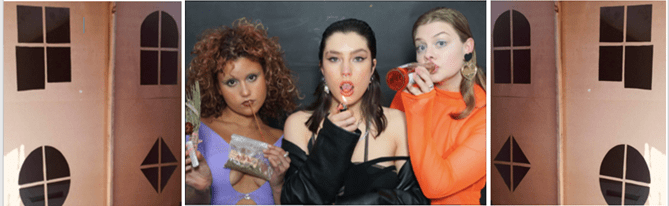
CLUB NITE is a hysterically honest insight into the reality of friendships after high school, navigating performative personas, and Melbourne nightlife.
After relentless begging from Gemma, Serena (Serene) and Ana reluctantly rekindle their friendships and agree to party with her for the night. The girls then go on a booze-filled rampage through three of Melbourne’s distinct party scenes in which each character has their moment of cathartic realization and self-actualization, forcing them to re-evaluate their true values and remember why they were all friends to begin with. Although the overarching plot is predictable, the distinct references and settings familiar to adolescent Melbournians strikes a raw chord leaving the audiences yearning for the Melbourne night culture we once took for granted.
Although this piece was a comedic exaggeration there were times in which the performers acting became too hyperbolic and unrealistic, to the end of disconnecting and hindering audiences from enjoying certain moments of the performance. However, staying with this piece garners the reward of many a witty one liner, piercing and amplifying the production, and re-submerging its audience into the narrative. CLUBNITE effectively raises and embeds contemporary concerns surrounding performative activism, effective allyship, and the value in social media influencing and online personas throughout the piece, leaving the audience evaluating their contribution and role in these spaces long after the conclusion of the show.
Whilst the original conception of the play intended it to be a piece viewed in person the translation into zoom does not deteriorate from the show’s value at all. Small physical gags pay off and the conversational tone of the piece lends itself well to minimal set changes and a set camera angle. I, and many others (I am sure), cannot wait to see CLUBNITE in its full in-person theatrical glory at Toff in Town this October as part of Melbourne’s International Fringe Festival.
 The Dialog