
By Lucinda Naughton
First performed in 2016, Andrew Bovell’s Things I Know to be True explores love and its damaging effects on a quintessentially suburban family in Adelaide. The Prices aren’t well off, but they aren’t struggling either; Bob and Fran have managed to bring up four children on the salaries of a retired car factory worker and a nurse. Just when the youngest is about to move out and things should be slowing down for them, the complicated lives of their offspring come crashing down.
Available on Digital Theatre+, Things I Know to be True is a Frantic Assembly and State Theatre Company South Australia Production, directed by Geordie Brookman and Scott Graham and captured live in 2017 at Lyric Hammersmith in London.
The entire production is superb. The play’s ongoing exploration of familial love is at times warm and comforting, and at other times incredibly suffocating and destructive. The truths that gradually tumble out from the family’s lives are both shocking and heartbreaking. The show explores how parents unintentionally treat their children in ways influenced by their own shortcomings, controlled by the fear that their children will make the same mistakes they did. It’s painful to watch a parent direct such anger at their child merely because they can see themselves in them. The play makes for powerful and truthful theatre.
‘It wasn’t meant to be like this. I thought they’d be like us. But better than us. Better versions of us.’
The cast of six are excellent. The play’s opening monologue comes from Rosie (Kirsty Oswald), the youngest of the Prices; she’s just finished school and has gone travelling in Europe. The monologue sets up the play beautifully and the character’s fierce love for her family is conveyed richly in Oswald’s performance. Rosie’s monologues bookend the play, and she represents the ‘coming of age’ narrative thread that weaves throughout and grounds the entire show. Her deep, unconditional love for her family remains constant, even when perhaps it shouldn’t. Every harsh truth that is unleashed feels all the more painful as the audience perceives it through Rosie’s innocent lens.
The first scene takes place inside Bob and Fran’s home, a set which remains the same almost throughout the whole play and is variably transformed into their backyard. Each member of the family repeatedly comes back to their childhood home – the place where everything began and nothing ever changes. In the first scene, the whole family gathers to welcome Rosie home from her travels in a makeshift, chaotic get-together around a table (which moves around fluidly on its own due to hidden mechanisms) that fits well with the fast-paced nature of the scene. Bovell’s dialogue, Brookman and Graham’s direction, and the cast’s intimacy are all excellent in portraying the multifaceted nature of the Prices. It’s hilarious and heart-warming to see the whole family together, and this first scene establishes real sense of the family dynamic. The script places focus on minute details, like why Rosie took a taxi home from the airport instead of calling someone to pick her up, a comment that is repeated by several characters. Here, we get our first taste of the underlying tensions embedded within the family.
Throughout the play, tension gradually builds as all four offspring have moments where they give astounding monologues about their inner realities and the true role they play in the Price family. Natalie Casey gives a gut-wrenching performance as Pip, the hard-working married mother, doomed to repeat her own mother’s mistakes. Richard Myland portrays the charismatic financial services officer Ben, a character who becomes so caught up with money and his image that he forgets the principles his father Bob has instilled in him, much to the agony of Bob himself. Matthew Barker plays the quiet Mark with great sensitivity and depth. The family unit is held together by Rosie’s love and the grounding yet critical disposition of Bob (Ewan Stewart), who brings great warmth and humour to the role, as well as Fran (Imogen Stubbs), who shatters us with her emotional depth.
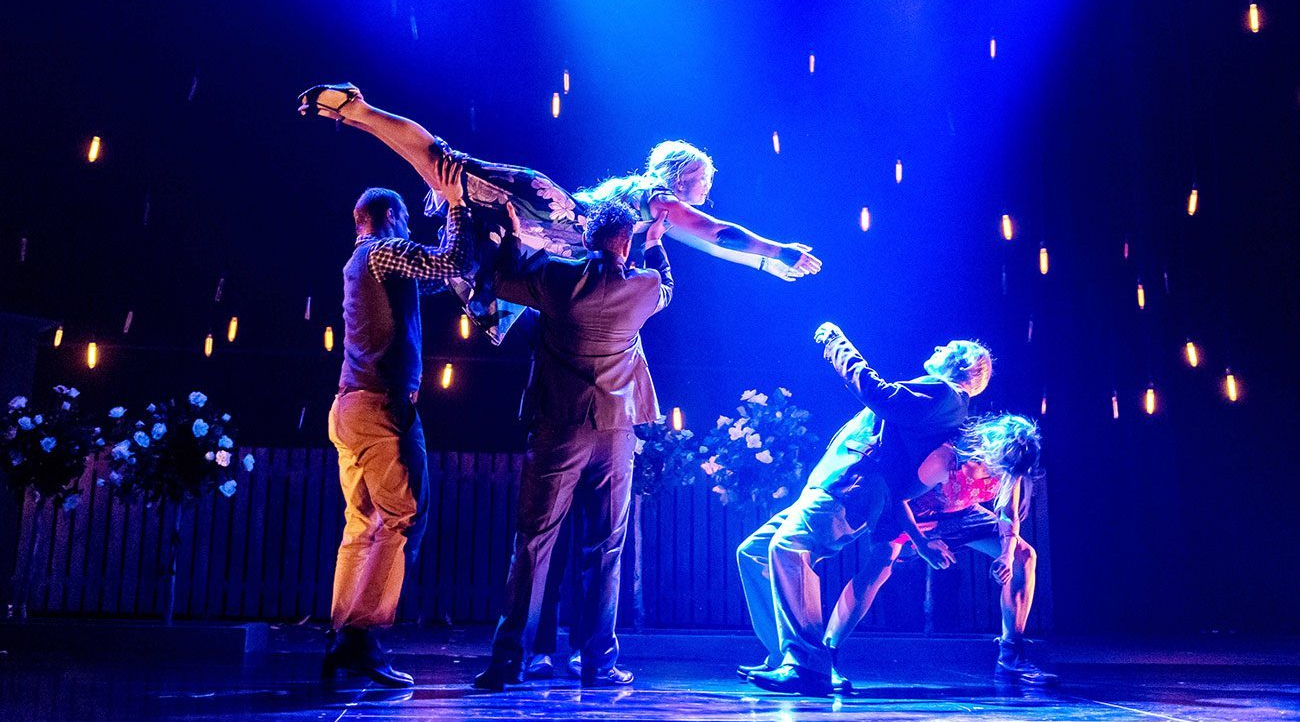
The play is a showcase for the celebrated physicality of Frantic Assembly, a production company that specialises in physical theatre. The moments of choreographed, dance-like movement performed by the cast gracefully breaks up the intensity of the drama within the play, giving the audience a chance to breathe and digest information. Sometimes the cast physically lifts or supports a character through their monologue during these dances, conveying the interdependence of the family unit beautifully.
Equally excellent are the major technical aspects of the production. Geoff Cobham’s set and lighting design is beautiful – fairy lights float from floor to ceiling in the backdrop of the set, and spotlights are used during both intimate and tense moments to up the ante. The lighting successfully reflects the tone of each scene throughout the piece. It’s warm when the family is outwardly happy, hiding their secrets, and it becomes cold when harsh realities are revealed. Alisa Paterson’s costume design also perfectly represents the nature of each character from the very first scene of the family get-together. Additionally, Andrew Howard’s sound design and Nils Frahm’s music adds so much emotion to the production and constantly compliments the action on stage.
This play is an absolute powerhouse of family drama, love and the shattering of personal realities. The deep, long-lasting effects family has on one’s character is beautifully portrayed within this piece of incredibly powerful theatre.
Frantic Assembly and State Theatre Company South Australia Production’s Things I Know to be True is available on Digital Theatre+ here.
 The Dialog