
By Christina Savopoulos
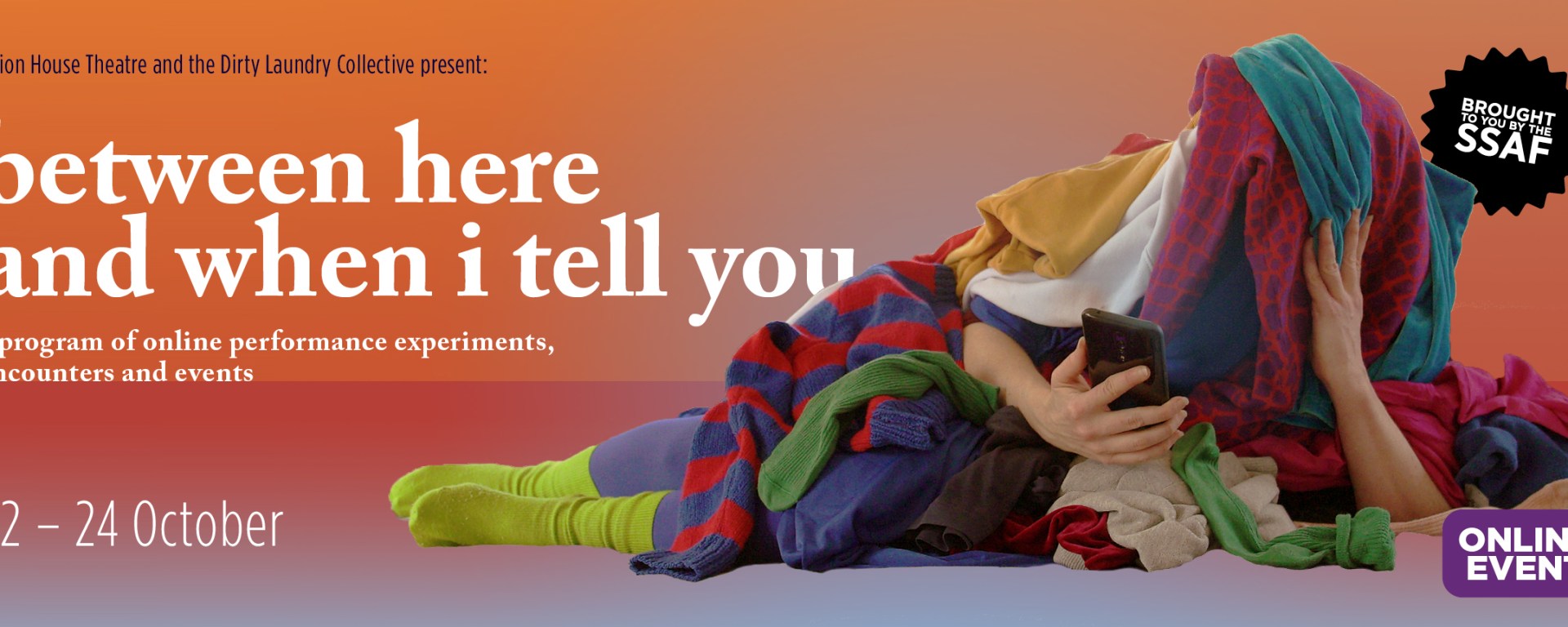
People have united, creativity has blossomed, and a glimmer of hope has been found in this time of stagnation. Online performances have risen in popularity with many wanting to experience something new, or to grasp at any connection with others. A collaboration between the University of Melbourne Student Union’s Union House Theatre (UHT) and the recently formed Dirty Laundry Collective has resulted in the project between here and when i tell you, a collection of online events delivered via a ‘web-stage’.
I sat down virtually with two creators of this event, Xanthe Beesley (Union House Theatre’s Artistic Director) and Harriet Wallace-Mead (Unimelb alumni, member of the Dirty Laundry Collective, and artist in the project) to better understand their process and the ideas behind creating this event that so many of us need – though some might not know it yet. Eight individual performances will be available on the web-stage, all responding to the themes of secrets and distance. Three additional events will also run over 22-24 October. Comprised of a BYO dinner party with a series of performances, a movement workshop and a casual performance lecture, there will be something for everyone. Both creators view the program of events as an “experiment”. They are physical theatre artists who have ventured into the digital world, a place with its own set of challenges, but I believe in the pay-off for all their creative efforts.
This interview has been edited and condensed.
Could you tell us a bit about between here and when i tell you?
Harriet: between here and when i tell you has many components. It’s sort of part promenade, part ‘wombat burrow’ – it’s designed to get lost in and find things. That being said, there is one way you can go through the work where you can see every single work one after the other in the order we’ve made together. Lots of little easter eggs hidden throughout as well.
Xanthe: between here and when i tell you is also an umbrella project for so many moving parts. As the year has gone on and as more ownership has been taken of this project by the artists that are creating it, more of those arms have been created and we’ve ended up with quite a tapestry of offerings. What’s been really interesting about between here and when i tell you is that it’s kind of a practice and a collaboration as much as it’s an outcome. Which is unique to this group of people and this particular work we’ve created in this time. It’s come from this time, and it’s been really responsive to the world at the moment, whichever way you want to think about it.
How did you start with the idea for this project and collaboration?
Xanthe: Every semester we do a UHT produced project, typically a play, a show or a devised work. It’s typically in a theatre or at least experienced in real life with people in a space together, whether that’s promenade work or installation based or in a theatre. The point is that it’s live face-to-face stuff. It’s my job to create those shows with the students. It’s my role to come up with the program. When we knew that we wouldn’t be able to do anything like that this year, I thought, I’ve got two options here – I can not do a show (which is totally legitimate in this time and people would’ve been really accepting of that), or I thought, well, we still have an opportunity to do something. And at that point in the year people were really buzzing with adrenaline as well, it was a weird space between despair and adrenaline to keep ourselves going. I thought, I want to do something. I want to do a project. I want to put something out there for the students because it’s the key responsibility of Union House Theatre to promote as many opportunities for the students as possible. I know that creativity is a really important thing to engage in all the time, but particularly in times of crisis. I wanted to take that opportunity to be creative too, for our students.
I contacted Harriet, who is an alumni, and we’ve worked together before on the last two Union House Theatre Shows. I said, ‘Hey we’ve got this idea of doing something, I don’t really know what yet, but these are the kinds of pillars and ideas. Why don’t we work on it and invite a couple other alumni to work on it?’ So, we’ve got a mix of graduate students, third year students that have shown a real interest in making work and some alumni as well. That’s about creating this community that we’re really known for at Union House Theatre. We started off with a sort of 6-week lab where everyone could come and talk about what type of artist they are and what kind of solo work they might want to make. We would set up frameworks and discussions to support each of the eight individual artists, for each of them to move through this time and explore what art making is to them. After that 6-week lab we went ‘Cool, what should we make now?’ It’s kind of gone a bit shape-shifty – we were going to make a dance film at one point, an installation performance at one point – but due to circumstances we’ve kept it all online and that’s been an extraordinary learning curve as well.
Harriet: Practicing together in this time is obviously super different. The eight of us that are sort of the ‘artists’ of the project, we all come from theatre backgrounds and all of us have done devising. But we have a lot of physical performers as well, and at first there were a lot of growing pains – ‘Oh god, now I have to be a digital artist and I have to make videos’. It was challenging, but the beauty of the project was that we were all experiencing that together. Being able to come together and know we were sharing that understanding was a bit of a catharsis or release. The process has grown, we’ve really found ways to find what piques our interest, like developing video editing skills. For me, I’m building the team website so I’m in the back-end all the time and doing things I’ve never done before – digital art and writing in different ways. For the second part, we all found one thing we’re really interested in and grew that into a bigger project and we have a nice mix of a lot of video works now. One of us has made a blog, and I’ve kind of got an online collage where you can click stuff and things open. It’s really different for theatre makers, it’s a really different way of experiencing time. The reality of the internet is that people don’t have to watch the whole thing, they’re not stuck in a seat in a dark room where if they leave it’ll be disrupted. It’s brought on a lot of challenges but also interesting provocations for how to engage an audience.
What is the biggest obstacle you have had to overcome during the creation of your project?
Harriet: Not being in the room together. It’s so weird. You don’t get the pheromones and at the end of rehearsal. You know, we used to all trot down to The Clive and now it’s like ‘Alright, bye’. So that’s been really tough because there’s only so much you can do to try and simulate those experiences; there’ll be multiple virtual rehearsals where we all stick around afterwards and chat and have a beer, but it’s just not quite the same.
Xanthe: Energy. Focus and attention. It’s very hard to hold a space when you’re not in the same space as people. The internet provides us with a digital life and distractions and sitting down to practice can be really draining on your body. I think that those things have been challenges. We’ve also made quite a long project. I think we did that because we were basing our timelines on what we know of making a theatre work; it can take years if you want it to. But typically, at UHT it takes a few months with rehearsals three times a week. We sort of replicated that in a way. But Harriet’s comment about ‘time’ is interesting – time is also different in the process that we’ve created. Something we’ve had to overcome is, how do we replicate a rehearsal room on Zoom? That’s not to say that it has the same mechanisms by any means, but how do we set up rituals like moving the body, preparing and warming up? How do you use some of the devising devices or directing tools to lead a conversation? There’s a lot of work in reviewing the tools that we physically use and adjusting them for an online world. So, whilst it doesn’t necessarily feel the same, we’re here together for a shared sense of purpose. Everyone is great and wants to be here, but it’s been hard because it takes energy – it’s the end of the year and there’s fatigue: screen fatigue, and pandemic and lockdown fatigue. The collective is working really nicely to support one another and develop a large sense of collaboration between the eight of them, but also these little micro connections depending on some of their skills or what people can offer – personal and artist connections. There are lots of these little electro synapses going out and making things buzz in a way to get that energy going.
What are your thoughts on the art and theatre community in this time?
Xanthe: It’s incredibly resilient but a lot of people are quite tired. There’s not one answer. There’s a lot of people out there who are trying really hard to make stuff. Some people are hoping things will return to some kind of normal and to a form they’re really passionate about making. And there are people who are really keen to kind of shape-shift and to adapt. I guess I’ll just say it this feels like a really important thing for this project that we’re working with eight young artists from really different art-making backgrounds who are really interested in adapting, even if it’s only for this time. I think what that’s opened up is way to look at the industry and at young makers who have the energy to keep going, who will bring their lived experience having grown up in a digital world. I like this project because I feel like it allows us a chance to be in dialogue with young people who I’m really hoping will have lots of ideas for the whole community and this time.
Do you have anything that you would like people to keep in mind when viewing your project?
Harriet: It’s an experiment. I would people to keep that in mind. It’s us trying something for the first time. As Xanthe was saying, it’s sort of this incredible little capsule of energy from the last few months of us all working quite intensely. Not just to make something, but to make something that we’ve never tried before. One thing that has seemed so apparent to me right now and why I’m personally grateful for this project is for all eight of us in this collective, we’re all very much on the cusp of trying to enter into careers in these creative industries where everyone has lost stuff during this pandemic. We all saw the next year of opportunities completely dissipate, as well as that feeling of forward momentum with your career. That freaked me out a lot, honestly. So, having this project has not only provided me with something to do but something to learn and to continue to grow. Also, the ability to come together in community – that’s what we’re all so hungry for and miss so much. I know that student theatre at Unimelb was how I had friends at university and most of my friends today I’ve met through student theatre at UHT. Being able to continue being in that conversation has been immensely valuable. And I hope that the project excites people and gives them some hope – maybe inspires them! And even if they hate it, that they’ll look at it and go ‘Oh, I could do that so much better’ and then they go do it. I just hope that some of that energy that we’re pouring into it gets transferred.
Xanthe: I think that’s a great summary Harriet. There are many ways people can engage. Simply viewing the website, viewing all of the works or just one of the works. Watching one a day or one a week. The “web-stage” will be up for a while. If people want this deep engagement with the process and the artists, with UTH and the Dirty Laundry Collective there are these three events also (dinner party, workshop and lecture), which we invite everyone to come along to. It’s an experiment. Depending on how we all feel and what it looks like, we will have learnt a great deal and it might be a blueprint that we’re able to use in the future in some way, shape or form so other people can have the opportunity to create work at Union House Theatre.
You can check out the performance experiments online at dirtylaundrycollective.com.au from 22 October.
Register for free to see all events for ‘between here and when i tell you’:
- The Dirty Laundry Dinner – Like your dinner a little different? BYO snacks and be guided through the performance feast.
- Movement Jam – A fun movement workshop with members of the Dirty Laundry Collective.
- Love and Loathing on the Internet – Book your tickets to this performance lecture about art and identity in the digital age.
 The Dialog