
By Sabrina Caires
Audience interaction. At its worst, it’s cringy and unnecessary, but when it’s done well it makes for a theatrical experience like none other. This was one of the main drawing points for Yael Farber’s 2014 production of The Crucible at London’s Old Vic – and oh, does it deliver. Through a unique, subtle take on audience involvement, an immersive soundscape and set, and a devoted cast, Arthur Miller’s 1953 script burns bright in this acclaimed production.
The play follows Miller’s interpretation of the Salem witch trials of 1692, in Massachusetts. When a young girl mysteriously falls ill, her cousin Abigail Williams reveals that some of the young women in Salem have been participating in rituals in the woods. A shadow of suspicion is suddenly cast over Salem, a Puritan colony previously untouched by the accusations of witchcraft which were plaguing the American colonies. The play is a frustrating look at how an affair, one individual’s false word, and a series of inconvenient coincidences brings the downfall of a town. Farber takes on the challenge of reviving this historical moment with flair and a clear commitment to her cast as well as her audience.
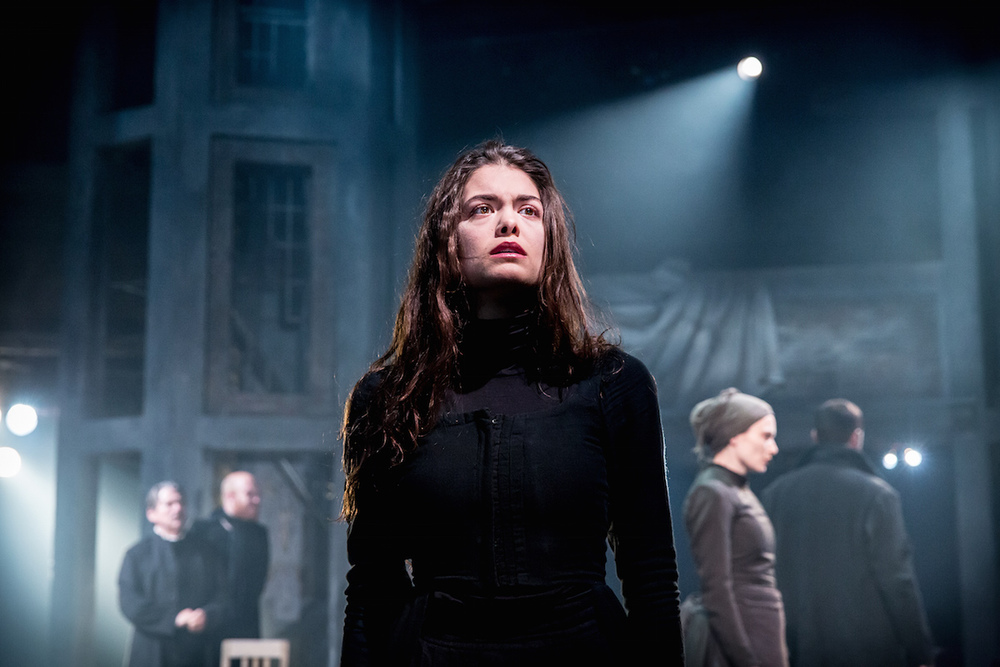
In the show, audience involvement takes place as the action occurs right in the middle of the theatre, with the audience surrounding it. Both actor and audience member share the same intimate space. Whilst audience involvement might typically entail conversing with audience members or being brought up on stage, Farber brings the stage to the audience instead, involving them directly in the action. This is a play where the stage is a space brimming with high stakes and heavy emotion. The small scale of the Old Vic Theatre means this works particularly well. In the digitally recorded production, seeing the audience captured in most of the shots almost serves as a reflection of yourself as an audience member. I felt the audience’s presence most strongly in Act 1 when we entered the home of John (Richard Armitage) and Elizabeth Proctor (Anna Madeley) for the first time. The audience is so close they can feel the warmth from the fire or even get splashed with water when John washes his face after a day of work in the fields. It’s the ablility to see the audience that reminds you that you are intruding on the domestic space of the Proctors – an uninvited guest in their home. This only heightens the viewer’s awareness of the discomfort and coldness Elizabeth displays towards John, depicting a household begging for warmth.
It’s Madeley’s choices here – her restrained movements and delivery of lines almost like a stilted song – that make the emotions of the final act even more impactful in contrast. During Act 1 it was Samantha Colley’s commitment to the character of Abigail Williams that enthralled me, but when Abigail disappears from much of the narrative in the middle of the play, Madeley certainly takes over in carrying the cast.
Alongside her is Armitage’s portrayal of a husband desperate for forgiveness. The rasp in his voice by the end of the performance indicates the sheer dedication with which he has thrown himself into this role. The cast as a whole match each other closely in their devotion to their respective roles. The choreography, the dialogue, and the world of the play feels fully inhabited through their creative commitment.
The backdrop of the set has a minimal colour palette, which is used expertly for two distinct purposes. Firstly, as a blank canvas upon which the impeccable acting skills and chemistry amongst the cast can take centre stage. This also means I notice any slight changes to makeup and costuming more than usual. At the end of the play, the impact of John being charged is clearly visible through the makeup on John, Elizabeth, and Reverend Hale (Adrian Schiller) – we see how time has elapsed in their faces, pale and hollow, eyes sunken in. Secondly, the combination of brown, grey, and cream illustrates the bleak world these characters live in.
It’s not only having the audience on stage that heightens the tension, but also the soundscape. For much of the play, this takes the form of a persistent drone which you became aware of every so often. It’s almost annoying, pushing you closer to the edge of your seat. At other times, it’s a violin which pulls at you, drawing up your emotion. The music is integral to the transitions between scenes, and in this digital incarnation of the production, so is the video editing. Blurry images fade into each other, creating a chaotic pause between scenes. This is a production where neither cast nor audience is ever truly left to rest. I remained hooked, watching the images flash across the screen to make sure I didn’t miss anything. Whereas during the live performance the audience’s eyes would have followed the actors weaving their way through the seats to either return or emerge from backstage, the editing provided something to keep the digital viewer engaged during transitions. This showed me the potential of video editing as a benefit of online performance. Modern audiences have become so familiar with the visual language of film – why not integrate it into theatre? Other productions which effectively utilised the film medium appear to have caught on to this, such as Marianne Elliott’s The Curious Incident of the Dog in the Night-Time (2018) or Robert Icke and Duncan Macmillan’s 2017 production of 1984.
I went into this performance having previously been meaning to watch it for a long time, and without having studied the play or even read the script. As someone who adores studying language and the way words can be artfully strung together, I know I’ve enjoyed a play when I want to rush out and read the script. Without a doubt, this production has made me curious to reach for that copy of The Crucible I picked up in an op-shop months ago and finally read it. This is a production which left me with many questions. Why did Abigail “confess” so readily? Considering Tituba is essentially puppeteered by so many people throughout the play, how was she really feeling during all this? However, if these questions have left me with any sense of emptiness or lacking, this only matches what I imagine the audience must have experienced emotionally in the aftermath of such a gut-wrenching performance. Farber has created one of those experiences where you step out of the theatre – or close your laptop – and feel empty for having left such a vivid world.
Watch Yael Farber’s The Crucible on Digital Theatre+ here.
 The Dialog