
By Lauren Walmsley
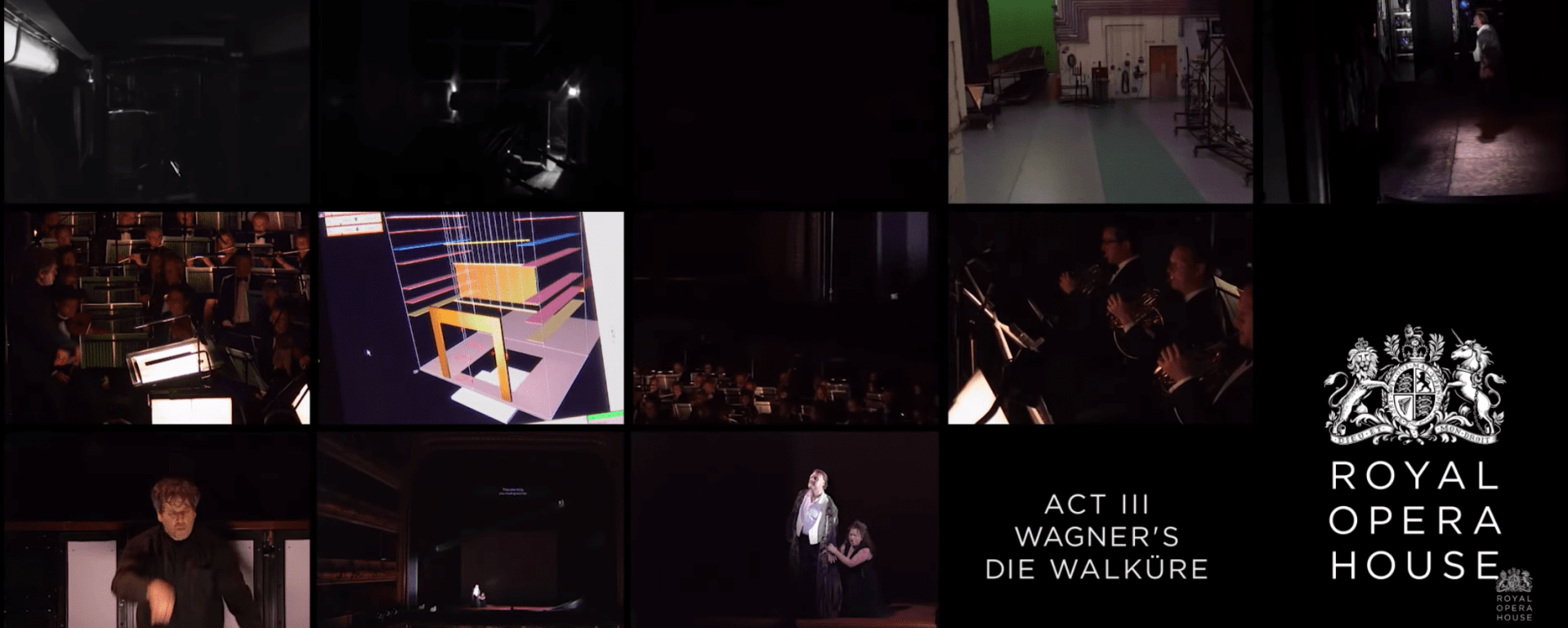
The best seats in the house are often in the stalls, front row and centre, but just imagine the wondrous views behind the curtain. In The Opera Machine, produced by the Royal Opera House UK, these exclusive views are opened up to the public, providing a rare insight to the behind-the-scenes makings of an operatic performance. Featuring the last act of the 2012 show of Die Walküre (the second drama in Wagner’s Ring Cycle), The Opera Machine shines a well-deserved light on the work of the stage crew, technicians and management. It’s those backstage rather than onstage who are the stars in this series of footage captured by 17 cameras placed around the theatre. Experience the opera performance through a different lens as you navigate through the online program’s exclusive footage and see all the thrilling action beyond the stage. Transport yourself into this high-pressure environment, feel anticipation for each cue and see for yourself how the world of Wagner is created.
Die Walküre is a story of controversial romance, as twins Sieglinde and Siegmund who are separated at birth later reunite and fall in love. Disrupting the destined paths of their lives set out by the gods, this tale of complex family affairs leads to destruction and a battle waged against the forbidden couple. Leader of the Gods, Wotan, bestows upon his daughter Walküre Brünnhilde the responsibility of bringing death to Siegmund. Choosing to defy these orders, Walküre sacrifices herself to save the couple, suffering the price of eternal mortal slumber surrounded by a wall of flames.
The Opera Machine is comprised of multiple interactive functions, allowing you to personalise your own experience of the opera. At the top of the page you’ll find a ‘how to’ section that mirrors the look of the live machine, where short descriptions on the use of each function is provided. Viewers are given the power to shape their experience with the machine, with the ability to choose whichever camera angle and audio they would like. The camera grid contains 17 different camera angles, each labelled with the location of its placement in the theatre. The views possible to choose from range from behind the stage to inside the orchestra pit or the front of stage in the lighting box, creating an uniquely multi-dimensional view of the theatre that would otherwise be inaccessible to the public. Depending on your personal interest the audio tracks can be also changed to include director’s commentary, backstage radio channels and the music from the orchestra. Even if you have no personal preference of what to view first, there is a pre-arranged version of the show, put together with seamless transitions of each camera angle that reflects the action as it happens. To top off this truly spectacular experience is the added bonus of the stage manager’s digitised prompt book, which has been programmed to flip pages in accordance with the scenes. Displayed adjacent to the camera view of your choice, this feature allows you to follow along with the sheet music and handwritten cues used by stage manager – a first-hand perspective into how intricate and precise the backstage world really is.
In The Opera Machine we meet Stage Manager Adam Lawley and Deputy Stage Manager Sara Woodward, whose constant communication is heard over the radio channels. In camera 2 we see Woodward leading the backstage team on every cue, from lighting and props to the amount of smoke needed on stage. The reactive, improvisatory nature of this role is particularly striking throughout the performance, where the mantra ‘the show must go on’ is the reality of the job. Moments before the fire wall is cast around Brünnhilde, we see the pyrotechnics’ preparation of the flames on stage and feel the rising tension when the flames almost malfunction. While there is a script being followed, we see how open discussion and observational decision-making is crucial in order to achieve the desired outcome. The director Keith Warner – described as having ‘nerves of steel’ – compares the significance of their job to a ‘moon mission’, as they are responsible for coordinating every single crew member while controlling all the happenings in coordination with the orchestra.
The dramatic ending to Act III of Die Walküre was a perfect choice to feature in The Opera Machine. As the shock-horror of Sieglinde and Siegmund’s true relationship is revealed, we see how the backstage crew bring to life the wrath of the Gods and portray the heroic actions of Brünnhilde. In the scene of Brünnhilde’s solo of forgiveness, there are no added lighting effects, drawing the audience’s attention to the soulful, atmospheric singing accompanied by sparse orchestral accompaniment. Yet behind the scenes, the management team continuously works in anticipation for the climatic points, counting down minute warnings to strike the light onto Wotan. This spotlight accentuates the figure of Wotan, evoking an impression of his divine power. These stylistic choices emphasise the grandeur of Wotan, distinguishing his almighty power over the belittled figure of Brünnhilde. The production’s interpretation of Wagner’s artistic intent is further explained in the director’s commentary as well as in the short introductory clip to The Opera Machine. These supplementary resources give greater insight into how historic authenticity has been balanced with the director’s own artistic direction.
All of the features available in addition to The Opera Machine’s central production are well designed and provide wonderful insight into every aspect of the work in a visually engaging way. As a viewer it feels like the theatre equivalent of a live sports game, following the action tensely as everyone works together to succeed – particularly with the added audio commentary. The multi-camera angle adds to the feeling that you are a part of the action rather than an outsider watching and learning. However, a more intimate interview with each key team member would have added an extra personal touch to the experience. The brief role descriptions beneath the production recording do provide some level of explanation, yet feel somewhat disconnected from the people we see at work in the Opera Machine production.
As a live audience, we only ever get to see the final result, sometimes forgetting how much unseen labour it takes to bring the production to life. The Opera Machine breaks down these barriers, showing us footage of the invaluable workers whose very purpose is to go unnoticed in real time. Whether you are a starved theatre lover or are looking for something a little different, the Royal House Theatre’s The Opera Machine is well worth watching.
Watch Royal House Theatre’s The Opera Machine featuring Act III of Wagner’s Die Walküre here.
and The Royal Opera’s Director of Opera Kasper Holten as they explain what Die Walküre
is about and introduce you to the staging.
 The Dialog