
By Christina Savopoulos
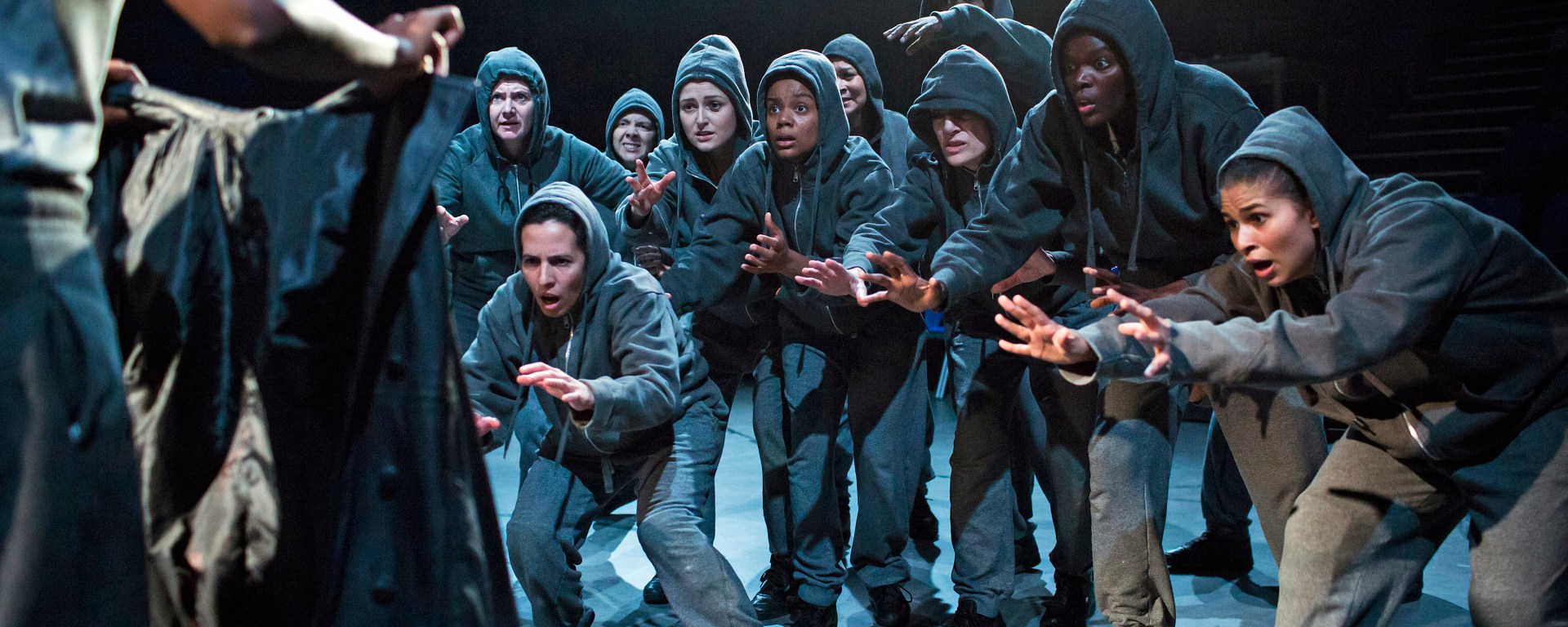
Friends, Romans, countrymen, lend me your ears. The metaphorical curtain opens on a barren space with a spotlight focused centre stage. If you’re familiar with Shakespeare’s Julius Caesar, you may be expecting a group of men to storm on, but director Phyllida Lloyd has something entirely different in store. This 2012 Donmar Warehouse production is the first in an all-female Shakespeare trilogy performed at Donmar King’s Cross in London. Shakespeare’s Henry IV and The Tempest follow this production, each with their own unique interpretation.
It’s a vast understatement to say that Shakespeare has successfully shaped the literary world; countless literature references his writings in some way or another, and there’s no end in sight of movies based off his work. Writers and directors are always looking for fresh, contemporary takes on the most adapted author of all time. That’s why it’s frankly no surprise that his work has yet again been reinvented to satisfy the needs of a feminist audience.
It’s also no surprise that this production was selected to appear at the 2017 Edinburgh International Film Festival years after its inception and was nominated for the Michael Powell Award for Best British Feature Film. Its approach to Shakespeare’s classic work is impressively original and should be applauded. With an all-female cast, set in a women’s prison where the prisoners themselves are performing the play, this is an interpretation we’ve definitely never seen before. The fact that the creation of the production had shared input from real-life prisoners grants a level of authenticity to the performance.
We’ve all seen Baz Luhrmann’s modern take on Shakespeare in Romeo + Juliet. In that 1996 adaptation, there remained a prominent sense of the Shakespearean aesthetic with a blended inclusion of contemporary references. This integrated approach to the classical features of the original text is missing in Lloyd’s production, which instead opts to portray a completely modern take on Julius Caesar.
Although the production doesn’t stray from the play’s negligible number of female characters, Lloyd’s decision to cast female actors of all races is a fantastic one and should’ve been undertaken sooner. Although innovative, the masculine presence of many characters somewhat undermines this decision and detracts from Lloyd’s choice. A sense of urgency created by the prison environment was successful in transforming this timeless work into a haunting portrayal of humankind. Emotional performances by the impeccable Jade Anouka as Mark Antony and Harriet Walter as Brutus communicate the play’s themes of betrayal, power, and morality. The setting of the prison prompts the audience to reflect on how these themes might adopt a deeper meaning.
As previously stated, Shakespeare remains the literary force driving many present-day creative endeavours. Yet his characteristically long monologues (however great) can become awfully dry when they take up much of a 2-hour performance. Oftentimes in the absence of an extravagant set, the audience’s focus is inevitably drawn to the dialogue and acting. I have no objection to this minimalist interpretative choice in theatre; I applaud directors when they allow for a focus on dialogue. However, this is not the case in Lloyd’s Julius Caesar. When it gets to the point where you can’t bear to hear one more speech directed to the people of Rome, Lloyd alters the environment, reminding the audience that this performance is being delivered in a prison.
The security cameras surrounding the performance space are a constant reminder of the prison setting, frequently displaying the prisoners as they perform vital moments from the play. The cameras display static or visuals of the prison cells whenever a prison guard interrupts the performance, usually to take a prisoner away for their medication. This causes continual shifts in the narrative being portrayed, and a comedically frantic search by the actors through the Julius Caesar play text to locate their spot in the performance. The actors needing to read momentarily from the script serves to remove the audience from the action onstage and remind them of their own role in viewing the production.
The inclusion of the sound of prison gates, a box of Krispy Kreme donuts, and the incredibly casual costume choices of prison-issue tracksuits and zip up jackets (with additional jackets thrown on to differentiate between characters) are all constant reminders of the production’s modern setting, effective in transforming the play. However, the incorporation of music at several moments throughout, particularly the heartfelt score accompanied by an acoustic guitar, is unwarranted and doesn’t suit the overall aesthetic established, instead disrupting the flow of the performance.
This production employs various Epic Theatre techniques, including that of audience alienation, effective in the positioning of audience seats surrounding the stage. The physical audience can grasp an overall view of the stage from all angles, just as we can by the camera angles in this recording. The production achieves the ultimate goal of commenting on the political prison environment and how Shakespeare’s work and themes transcend time and space.
Designed by James Farncombe, the play’s fluorescent white lighting resembles that of the prison, however the exquisite alteration to this design when the characters conspire against Caesar is mesmerising. The actors’ use of handheld lights to illuminate their faces creates an eerie and ghost like atmosphere, underscoring the play’s themes of betrayal.
Leading up to the famous scene of Caesar’s death, he takes his position in a front row seat of the audience. Others proceed to stab him numerous times much to the horrified reaction of audience members. This scene is such a vital moment in the production, a critical event of betrayal and change, but the execution of the scene (pun intended) was subpar. A scene such as this is intended to elicit horror, revulsion, or some other strong emotion, yet it only left me mildly amused at its slightly pathetic portrayal. The scene didn’t feel grounded in the world of the performance and seemed detached from the wider aesthetic of the production. It’s possible this scene might have succeeded in moving me had I viewed it in person. In my viewing experience it was, however, somewhat redeemed by the wearing of red gloves by all the murderers, an inventive way to visualise the line “bathe our hands in Caesar’s blood” without creating too gory a performance.
Although watching this production on a small screen from the comfort of your home comes nowhere near the experience of viewing it in its original London theatre, it makes for a captivating watch thanks to its fresh interpretation and modern aesthetic.
The Donmar Warehouse production of Julius Caesar can be viewed at DigitalTheatre+ here.
 The Dialog