
By Jean Baulch
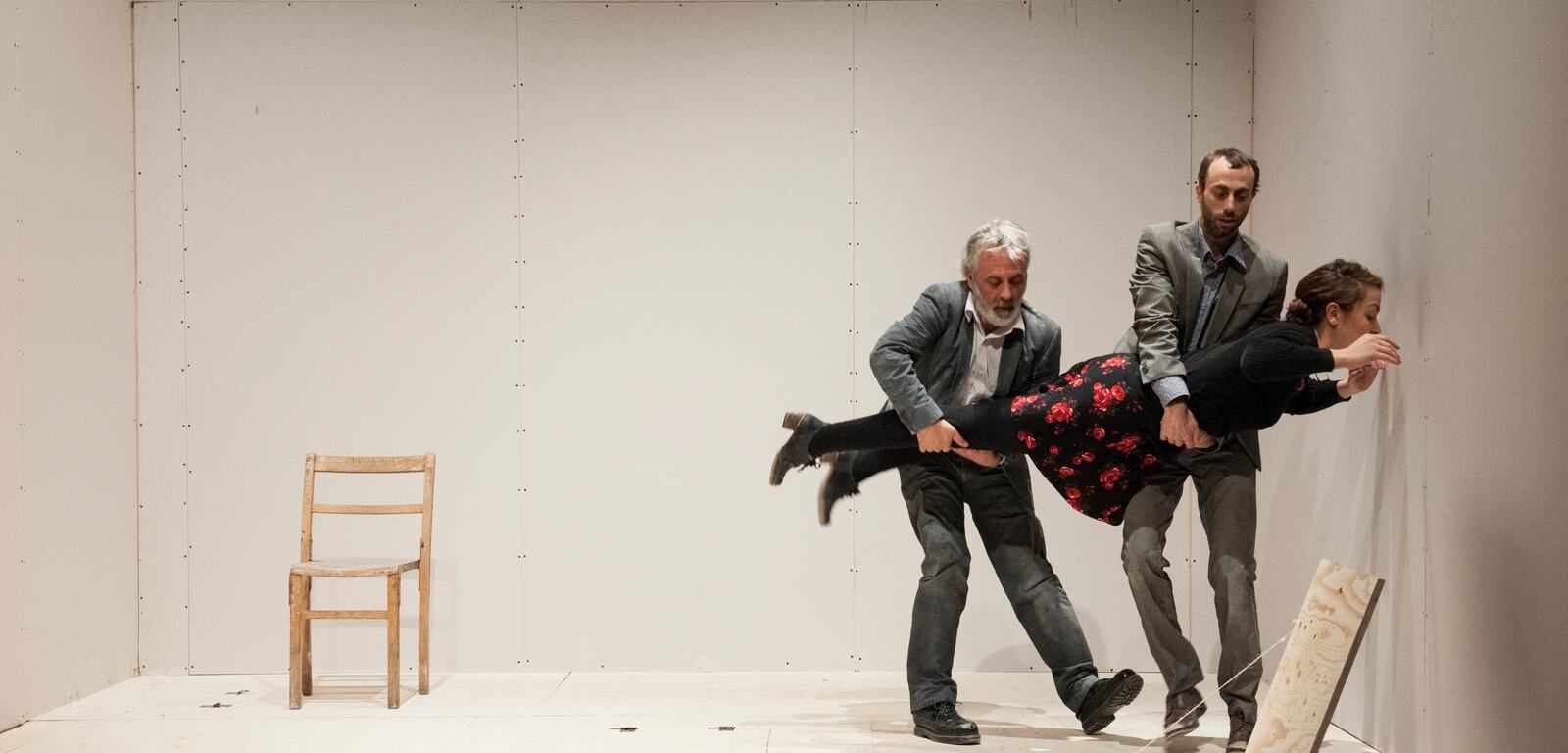
Negative Space, the work of UK-Belgian company Reckless Sleepers and director Mole Wetherell is a whirlwind of visual theatre, captured live at Adelphi Theatre, University of Salford in 2019. It takes the established worlds of physical and devised theatre and fits them out with an armoury of hammers, trapdoors, rose ceremonies of sorts, and broken walls. The performance presents a symphony of body language, inviting you into a place beyond words where movement and logic translates into a hypnotic composition of codes and riddles. There is no sense of a conventional narrative – instead, the doors are thrown wide open to the audience’s own imagination.
The central motif in this performance is hammers ripping holes in walls. If you’re renting and frustrated by your lack of rights to tap some nails into your walls to hang your art, then this is a dose of vicarious victory you’ll want to taste right now. If the walls of your house are caving in on you under these current COVID-19 restrictions, and you find yourself daydreaming about ripping them down, then Negative Space is the energy you need right now!
Negative Space opens in a world where the rules of gravity have shifted; a simple stage made from a white floor and three white walls floats weightlessly in pure darkness. The rules of an ordinary room have no place here – each surface is now its own dimension, with its own ideas about how space and humans might behave. A cast of six weave through the space, interacting with each other and the walls in unpredictable ways – heads, limbs, and whole bodies drop in, pop out from, and tumble through walls, hug, fight, and present each other with roses. There is a gripping tension created through these bodies in action, and in their hands is an array of mundane household objects getting up to mischief and mayhem. My favourite of these is a kitchen brush (going it alone without its dustpan) that takes on the classic role of the cat in the evil villain’s lap. Throughout the performance the facial expressions of the cast are understated and used deliberately, and in the complete absence of dialogue their impact hits with startling intensity.
The lighting is subtle and a technical triumph, allowing the minimalist stage to embody a range of forms in a single setting. After its free form, floating entrance, the lighting shifts slightly to allow a shadowy world to appear on each side of the stage. In a normal production these would be the wings, hidden out of sight, but in Negative Space they become active. As the performance unfolds, humans and objects start to filter back and forth. A surreal dialogue develops between the two spaces, built up through a language of mirrored, inverted, and reactive happenings, all open to infinite interpretations depending on your imagination.
The plasterboard walls undergo a violent and humourous DIY home reno gone awry. Hammers with red handles reign supreme, and they dance through the space, wielded by human hands to map out emotions in plasterboard damage. At first the blows feel random, but it quickly becomes clear there is a tight choreography at work. Each time a new hole is torn through the paster board, the space grows more and more alive with dappled patterns of light. By the end, the stage has become wreckage, and no longer floating but very clearly grounded on the same floor as the audience’s chairs. The damage is so vast that even its internal structure of wooden beams is now laid bare.
Walls are deeply recognisable boundaries in our everyday lives. They are physical boundaries, as well as mental boundaries that mark out our days. They are assumed to be solid, static, immoveable edges. Yet in Negative Space this recognisable boundary of the wall is always in play. The walls themselves are a character, a tactile space encompassing all five senses. The cast put their ears to it to listen, knock holes it in to make sounds; they touch it, smell, taste and see it. It is a playground filled with all the possibilities of sixth sense magic. These walls have their own energy that the cast seem to be trying to divine. Often, they touch a wall with their hand like it’s home base in a kids’ game, to mark themselves as safe for a moment. Other times, they put both hands up in the freeze position – as if negotiating a strange new code of safety in the presence of another, a system of communication that can only be guessed at by the audience. It makes for a curious portrait of humans grappling with the feeling of existence, the awkwardness of bodies arranging themselves within a compressed social space.
It feels particularly powerful to watch this performance during these weeks of isolation – it speaks deeply to anyone wondering if it’s normal to want to hug everyone you live with as tightly as possible in one moment, and scream so loudly they all evaporate in the next. Though the play was devised and performed well before COVID-19, it reaches into our current experience with a cutting honesty.
As I watched this performance with wonder, laughter, and horror, the energy of those walls leaked into my home. The walls I’m surrounded by then began to feel different – filled with possibilities and opportunities for playfulness that I’d never seen in them before. There’s currently a moratorium on house inspections, so…
Negative Space, by director Mole Wetherell and Reckless Sleepers is available on Digital Theatre + here.
 The Dialog