
By Lucinda Naughton
Sam Shepard’s 1979 Pulitzer Prize-winning play Buried Child explores a Midwestern-American family holding onto a dark secret in the ‘70s. The arrival of their grandson Vince, whom they do not recognise, sparks the intense unravelling of that secret. In The New Group’s 2016 production, directors Scott Elliot and David Horn capture the essence of Shepard’s original work, creating a show that manages to be both hilarious and horrifying in the same minute.
Shepard’s postmodern family drama explores the familial relationships that shape and haunt us. While the next generation can try to diverge from their flawed family history, ancestral patterns tragically and inevitably repeat themselves. This lack of one’s own free will is a confronting concept.
Shepard’s writing in Buried Child is superb. There is a wonderful rhythm in his language, which is the result of the exquisite balance he constructs between naturalism and poetry. The balance of these stylistic elements is what stood out the most to me in the play. The audience experiences the forthright reality of how this dysfunctional family lives and what they’ve been through – in this, my god, Shepard does not hold back – but these grim experiences are juxtaposed with the beauty of the language. The truthful force of the dialogue is particularly beautiful to behold in the monologues.
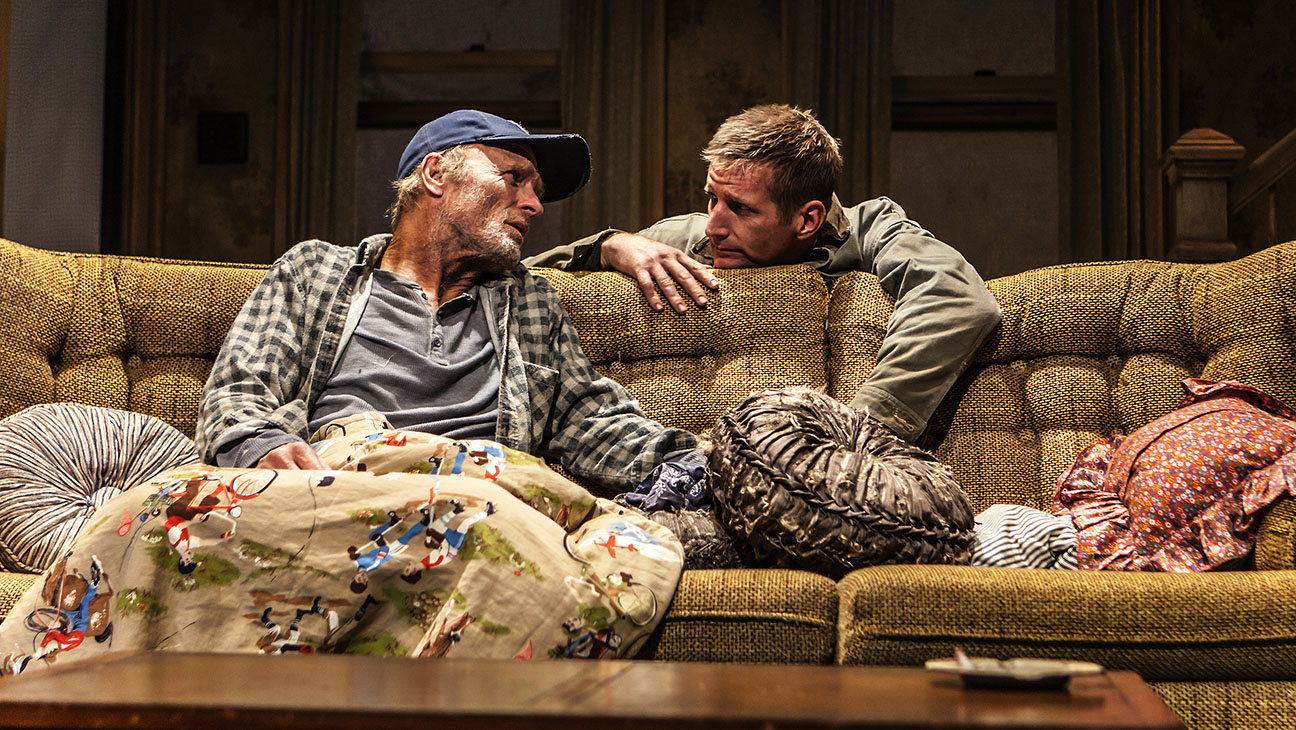
The cast who executed the beautiful balance of Shepard’s rhythm were incredible in this regard; however, the specificity of rhythm meant it was equally obvious when an actor fell short. Ed Harris’s portrayal of Dodge, the man of the house who doesn’t want to fulfil his duties anymore, is knockout. As is Paul Sparks’ performance as his son, Tilden. Harris and Sparks feel as though they’ve been plucked right out of a struggling family in 1970s rural Illinios. Harris captures the sense of hopelessness present in Dodge, a character who isn’t sad that he is finished with life – he is simply just finished with it. As Sparks draws us into his character we are filled with a sense of unease as questions arise – what’s going on in his mind? What’s he not saying? Why are Dodge and his wife speaking about him as though he’s not in their presence? Sparks captures your attention instantly and never relinquishes it. Sparks and Harris portray a realness that is uncomfortable to observe at times. It is difficult to look so intimately into a family’s life; every awful secret comes out, instead of being left swept under the rug. The actors make us face their characters’ hard reality.
Amy Madigan’s performance of Dodge’s wife, Halie, is also very powerful. Her character presents a point of contrast to Dodge. While Dodge, absent and an alcoholic, is not completely attached to reality, Halie is far more out of touch. While she’s lively and quick to boss Dodge around, she is the most afraid of the family secret, wanting to leave it unspoken and live in a fabricated world she’s created to cope with the weight of the truth. Larry Pine’s performance of Father Dewis is also great. Shepard uses his character to bring some comic relief to the play; when chaos is unleashed, Halie looks to Father Dewis for support, but he simply stands back to watch, claiming, “This is out of my domain!”
Rich Sommer as the other son, Bradley, is good, although sometimes his anger feels a little forced. I enjoyed Nat Wolff’s performance as the grandson who arrives at the house after many years of absence; he has an intense monologue at the close of the play. The monologue reflects the idea that we are our family and will inevitably repeat their behaviour, which leaves us with a tragic sense that hope for change is lost.
Yet Wolff, along with Taissa Farmiga, who plays his character’s girlfriend Shelly, feel a little too contemporary for the established world of the home in the ‘70s. Susan Hilferty’s costume design, while perfect for the other characters, fell short for the young couple by adding to their more ‘modern’ feeling. Perhaps this contrast was intentional – to show the youth and vigour of the next generation living in a reality that this family no longer partakes in – but I felt it was too jarring. Farmiga also does not succeed in nailing the rhythm of Shepard’s language and therefore leaves the potential of her character unfulfilled. As the only outsider (apart from the passive Father Dewis), Shelly could have served as a mediator between the high dysfunction of the family and the audience. Yet I found myself struggling to empathise with her, as Farmiga did not ground her vocal performance enough and missed the mark. Elliot and Horn perhaps fell short in their direction here.
Derek McLane’s set design is warmly detailed, taking the audience back to a sweetly shabby depiction of 70s realism. I enjoyed the flexibility of the set – the kitchen leads offstage to the farm outside and a staircase leads upstairs to the bedroom, creating a sense of the whole house even though we only see the living room. Peter Kaczorowski’s lighting design and Jeremy S. Bloom’s sound design also add to the feeling of the rural homestead in the ‘70s; the lighting is simple and the music subtly adds to the emotional storyline throughout the play.
While there were a few parts that fell short, I felt the production of Buried Child had more than enough strengths to convey the world of the family in a visceral manner. Shepard’s writing is truly potent, Harris’ and Sparks’ performances are superb, and the production creates a very real, challenging world for its audience. To see a performance of Shepard’s work this well done is definitely worth a viewing.
Watch Shepard’s Buried Child on Digital Theatre+ here.
 The Dialog