
By Linus Tolliday
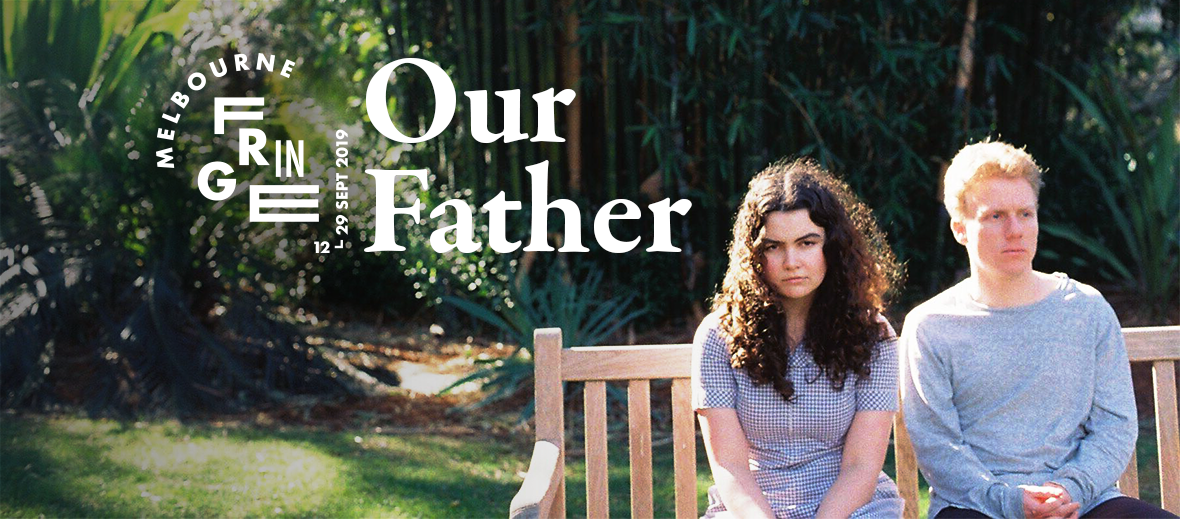
Playing as part of Melbourne Fringe Festival, Our Father is a considerably dour effort that takes the Royal Commission into Institutional Child Abuse and turns it into a very human drama. Structured mostly as a series of police interviews of the family of an accused man, there is a simplicity to the narrative that brings the characters and their experiences to the forefront. The mother, in a desperate turn by Sandy Morrison, is a well-meaning denial-case; the daughter, played with aloofness by the writer, Lucy Holz, is too detached to let herself see the repercussions of her father’s actions; and the son, in a melodramatic performance by Will Hall, is angst-ridden and standoffish in his it-should-have-been-me complex. The family is divided and in crisis, brought together only by the police officer, played with warmth by Benji Groenewgan.
The dialogue oscillates between understated implications and moments of pained over-sharing. The relationship between the son and daughter, in particular, feels organic and taps into a universal experience of confusingly muddled empathy and apathy. She understands that he is in pain, but she also can’t help but see his pain as self-serving and indulgent. And it is. But that’s what the audience is asked to grapple with: are the son’s actions justified in the circumstances? Is it possible for him to show his mother forgiveness for her seemingly wilful naïveté?
There is never a yes or a no to these questions. In the throes of running away from home, the son has a chance encounter with a caring service-station worker, also played by Groenewgan, and sees his pessimism has gone too far. He returns to complete his interview and the police officer finally encourages him to just be honest and answer the questions. It’s quite a tidy resolve; the son has his arc, the officer his answers and the audience a sense of justice.
It’s a sad story, that much goes without saying. The problem is, though, it seems to derive its sadness from other stories about the commission. All the characters are stock characters we’ve seen a million times before, and their relationships simmer with predictability. The mother’s denial is never explored beyond its surface, while the daughter is quickly sidelined after a couple of quasi-revelatory monologues about her own hardships. This is a melodrama that rides on the coattails of a whole artistic movement and comes across as too generic to escape an unfortunate hollowness.
Let this not detract from its strengths, as the performances are consistently strong from all players and the dialogue imbues the static narrative with momentum. The set too must be commended for its dynamic use of a sparse aesthetic. The lighting is minimal and gritty, ever threatening to cast the stage into darkness. The only issue, really, is the uninspired ebbs and flows of an all-too-familiar narrative. And with subject matter of such gravitas, cliches are twice as damning as they otherwise would be.
Our Father is a flawed assessment of one of the darker periods in recent history, but the cast and skilful staging more than make up for these consuming albeit minor issues.
 The Dialog