
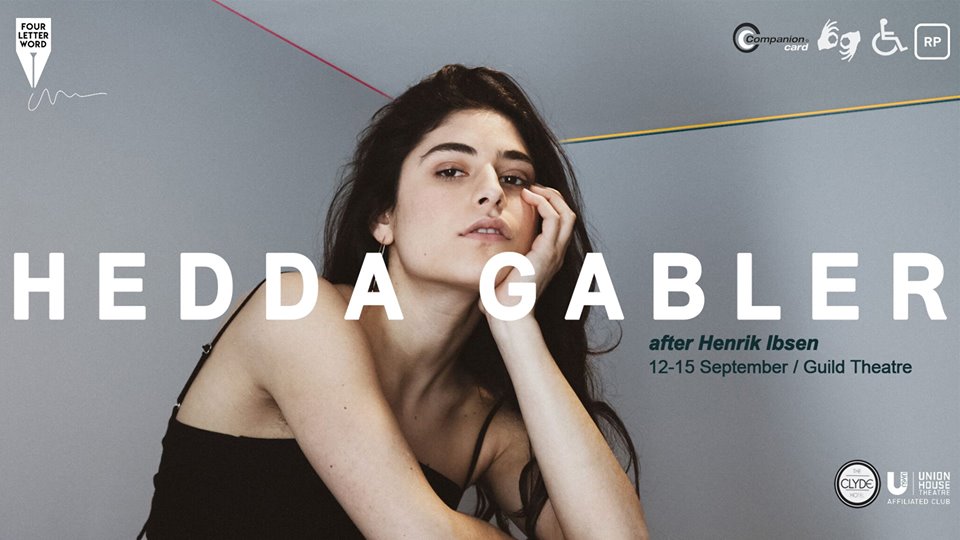
Venus Notarberadino as Hedda Gabler flips between a weighted stillness and erratic movement. She stares at nothing, caught up in her own mind, pulling the audience in. She’s the centre of Four Letter Word’s impressive adaptation of Henrik Ibsen’s Hedda Gabler, which opened this Wednesday.
In a new adaption by Arthur Knight and Simon Farley, Hedda is brought into the modern era, dressed in a black jumpsuit but retaining all the complexity of her original iteration. Directed with care and vision by Kate Douglas, Hedda and her dysfunctional ‘family’ feel very real, and painfully familiar. Hedda’s cruelty is made more believable by beginning as charm – she’s snide and sardonic, but funny – making her manipulation all the more powerful, and her final act devastating. Updated yet timeless, this production is thoughtful, a clever balance between delicate and explosive.
While the show is carried impressively by Venus’ Hedda, who is on stage for most of the play, the supporting cast colour in the world around her with depth and nuance. Luke Macaronas’ Jørgen is sweetly naïve, capturing the haplessness with which he greets his unhappy wife. Eden Gonford is a powerful and commanding Brack, casting a dark enchantment over Hedda which seems to take up the entirety of the Guild theatre. The other women in Hedda’s life are equally deftly played. Ann-Marie Biagoni plays Thea as never fully comfortable, and emotionally demonstrative where Hedda is reserved. When Hedda pulls her to the couch to stroke her hair, her face reveals all her confusion and awkwardness. Bronte Gosper’s Aunt Julle is a warm presence, the character’s kindness shown in Bronte’s easy gestures and open face. Frankie Roberts’ Berta is almost a stand-in for the audience, refreshingly sane amidst the more unstable characters. She tiptoes around Hedda, knowing before we do the harshness beneath Hedda’s quiet contemplation. Finally, Darby Turnbull’s Løvborg is the disturbing force which destroys the gloomy peace of Hedda and Jorgen’s new home. He captures the darkness bubbling beneath an approachable exterior. The show is extremely well cast – the relationships between these prickly people feel right and real.
The play’s visuals complement the work of the cast, a marriage of realism and symbolism that subtly communicates the plays dysfunctional relationships. Lines of colour stripe down the off-white panels that make up the house’s walls, their out-of-place vividness calling to mind the men who bring destruction down on Hedda. A standout set piece is the set of blinds that stay closed for most of the show. They add a feeling of entrapment, of being closed off from the outside world – light filters through in strips, casting shadows on the walls of the theatre like bars. The mirror on stage left, while a realistic addition, also feels symbolic – we see sides of the characters they might not be intending to show, and maybe we’re reflected there too. The music, simple discordant piano, sneaks in at opportune moments, giving an eerie sense that we’re hearing Hedda’s descent into her darker thoughts.
Douglas and the cast’s handling of the shows dark themes is to be commended – they don’t shy away from the bleak ending of the play. They make it feel tragically earned – while Hedda is in some ways an unknowable force, she also feels recognisable. She could be anyone, and anyone could become her. The show reveals how she came to the brink, and makes us watch, but more than that – it helps us understand.
Caitlin Wilson
Four Letter Word’s production of Hedda Gabler runs from the 12th – 15th of September in the Guild Theatre.
 The Dialog